
Ali Al-Taher Hill: What does Israel’s declaration of control in Lebanon mean? – BBC News Arabic
was published
Reading time: 3 minutes
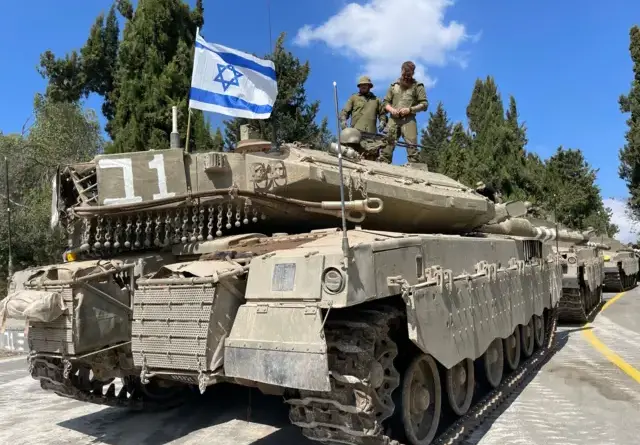
The military events at Ali al-Tahir Hill cannot be considered in isolation from the general military and political landscape.
The frenzy surrounding this exposed strategic hill may indicate that its control, if confirmed, is an episode in Israel’s gradual advance into Lebanon and the expansion of its occupation of the south, while militarily strengthening that occupation.
Israeli discourse has ranged from the need to create a security belt to expanding what is described in Israel as a security zone.
While this announcement does not necessarily mean an end to the expansion of Israel’s occupation of southern Lebanon, it does indicate the military importance that the Israeli army attaches to the area.
This is what Hezbollah MP Ihab Hamade tried to play down, noting that the Ali al-Taher Hill site “like any other site or hill in southern Lebanon has a purely existential value, and Israel’s control of it is not a disaster in military reality, nor the end of the matter.”
In an interview with Sputnik Radio, Hamada questioned Israel’s control of Ali al-Taher, saying: “How can Israel’s enemy claim control over Ali al-Taher Hill when it is still constantly bombing and raiding it?! Knowing that it controls it from the air or from all sides geographically, so that its forces cannot enter the site or control it.”
field on it.
The BBC has been unable to independently confirm Israel’s claim of operational control of Mount Ali al-Tahir.
Ali al-Taher Hill is located north of the Litani River, six hundred meters above sea level and 15 kilometers from the border. It overlooks the entire Nabatieh region and the hill connects the border areas with the Iqlim al-Tufah region to the south.
In this context, retired Brigadier General Fadi Daoud says that the hill of Ali al-Taher represents “the entry line, it is the gate or the entrance to the rest of the south. If Israel wants to develop its military action, it will be through this gate to enter from it the last sector of the south, which extends from the Zahran River to the Ahran River to the Awakwa River. The heights of Iqlim al-Tufah, i.e. Hezbollah’s last stronghold in southern Lebanon.”
According to Israeli officials, Hezbollah has built a very extensive and sophisticated network of tunnels under Ali al-Taher Hill over two decades, and that these tunnels are an important part of the party’s military infrastructure. Hezbollah’s control of the hill also allowed it to fire short-range rockets and drones into northern Israel.
Hours before Israel’s announcement, Reuters also published a report saying that Iran had informed the United States that it would respond strongly to any attack on Ali al-Taher.
Although there will be a lot of talk about the equations established by the new reality of the South, “post-Ali al-Tahir”, for example, the so-called preventive intervention of Israel.
In this context, the timing of Israel’s declaration of control over it is believed to give Prime Minister Benjamin Netanyahu a domestic political boost at a time when his government is facing many challenges and Israeli elections are approaching. The announcement could also represent a new blow to Hezbollah’s military image if full Israeli control of the site is established.
It also comes at a time when attention is being paid to the possibility of renewed rounds of direct talks between Lebanon and Israel, although no confirmed dates for any new rounds have yet been announced.