
US backs Saudi Arabia, Oman and Iraq militarily as oil prices rise again – BBC News Arabic
image source, Getty Images
was published
Reading time: 4 minutes
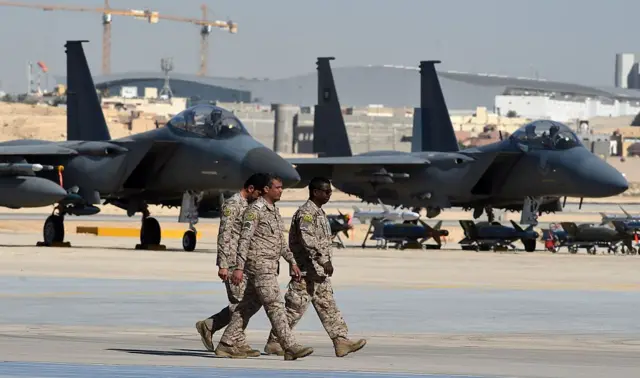
The US State Department has approved potential military sales agreements with Saudi Arabia and Iraq, including munitions, engines and helicopters, in the latest round of US arms deals with the two countries.
The developments come as oil prices rose significantly during the week, amid renewed tensions between the United States and Iran and ongoing disruptions to shipping through the Strait of Hormuz.
The US State Department said on Friday it had approved a potential deal to sell Saudi Arabia a “Joint Extended Range Direct Attack Munition (JDAM-ER)” worth an estimated $5 billion, with Boeing as the main contractor.
The ministry also approved another potential deal to sell AGT 1500 engines to Saudi Arabia at an estimated cost of $750 million, with Honeywell as the prime contractor.
Thus, the estimated value of the two potential deals with Saudi Arabia reaches $5.75 billion.
“Joint direct attack munitions” are used to convert unguided bombs into precision-guided munitions, while the long-range version allows them to hit targets at greater distances.
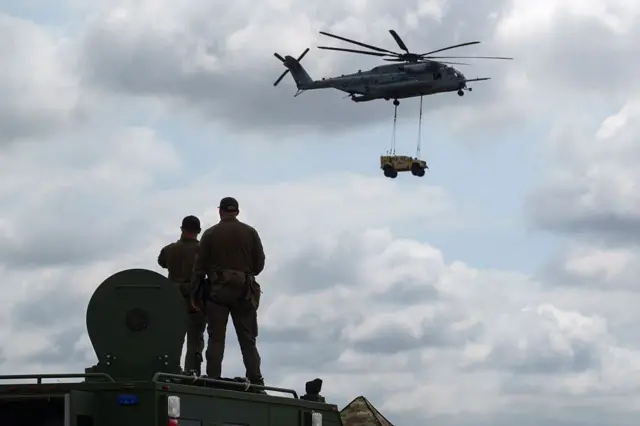
image source, Getty Images
Separately, the US State Department said it had approved the potential sale of $150 million worth of Bell 412 EBX helicopters and related equipment to Iraq, with Bell Textron as the prime contractor.
The approval comes days after Washington announced approval of a broader potential military deal for Iraq, worth about $800 million, which includes Bell 412 EBX and Bell 407M helicopters, weapons, sensors, equipment and technical and logistical support.
Washington said the broader agreement aims to strengthen Iraq’s airlift, intelligence and ground targeting capabilities to help it counter current and future threats.
The US State Department’s approval does not mean the deals are complete, as they represent a step in the US foreign military sales process and the final cost and equipment may change before the contracts are signed.
The US State Department said on Friday it had agreed to provide maintenance services for F-16 jets and other related equipment to the Sultanate of Oman at an estimated cost of $188 million.
High oil prices and disruption of tanker traffic
Oil prices rose on Friday to end the week with significant gains after a renewed military standoff between the United States and Iran entered the seventh month of the conflict, as oil tanker traffic in the Middle East continues to face turmoil.
Brent crude futures settled at $92.68 a barrel, up 76 cents, or 0.8 percent, while West Texas Intermediate crude futures settled at $91.48 a barrel, up 18 cents, or 0.2 percent.
For the week, Brent crude rose 7.6 percent and U.S. crude rose nearly 10 percent as oil supply routes in the Middle East continue to suffer from war.
Rising oil prices, along with higher fuel price increases, have pushed up inflation and government borrowing costs around the world, fueling fears of a slowdown in global economic growth unless pressure on energy markets eases.
Although the US government has said that oil flows from the Middle East have returned to normal levels in recent weeks, analysts and tanker tracking data indicate that shipping is still facing major disruptions.
Preliminary shipping data showed four cargo ships crossed the Strait of Hormuz on Thursday, well below the previous ten-day average of about 15 ships.
Norbert Rocker, Julius Baer’s head of economics and next-generation research, said the stalemate and renewed hostilities have repeatedly activated the “risk premium” embedded in oil prices.
He added that there are no indications yet that this week’s escalation has significantly affected Middle Eastern exports or led to a shortage in the oil market, given that the current rise in prices is largely driven by fears and market sentiment.
This week’s American attacks, which killed and injured dozens, including Iranian civilians, were the most violent confrontation between the United States and Iran since July.
Meanwhile, three senior Iranian sources said the US campaign to stifle Iran’s economy by blocking its oil exports and countering efforts to circumvent sanctions has become more difficult for Tehran.
Iraq’s oil exports rose to about 2.34 million barrels per day in August from about 1.35 million barrels per day in July, according to Iraqi energy sector officials.