
Experts: Iranian wedding was targeted by US munitions
Published on 4/9/2026
On Thursday, Iranians held funerals for the victims of a US airstrike that targeted a wedding party in the Strait of Hormuz in Sirik province, killing four people and wounding 68 others.
US Vice President J.D. Vance commented on the incident and said the United States was investigating the raid.
He added at a White House press conference: “If we make mistakes, that’s the big difference between us and Iran. When our military makes mistakes, it learns from them and tries to improve its performance.”
direct hit
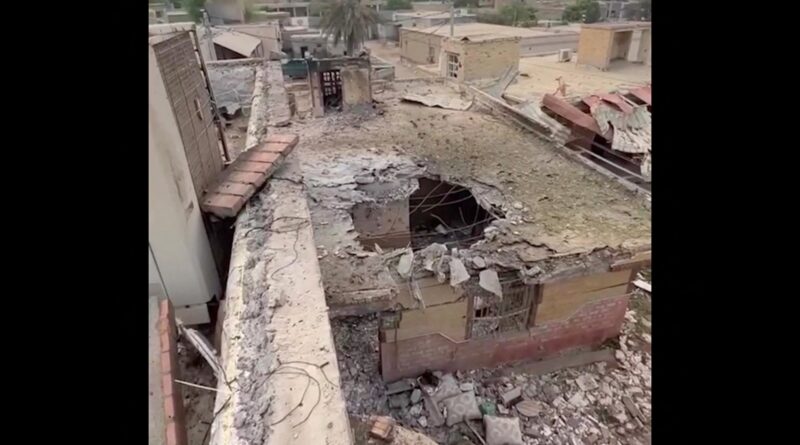
Four military weapons experts, after reviewing video clips and images of the incident provided to them by Reuters, said the damage was consistent with the circumstances of a direct hit and not secondary damage caused by the ricochet of a second target projectile.
Three of them believed the missile was a US weapon and not an Iranian air defense missile that had lost its way, while one of them said: “The missile may have just missed its target.”
Gareth Collett, a retired brigadier general in the British Army who specializes in bomb disposal in the context of counter-terrorism and holds a PhD in explosives engineering, said: “It happens from time to time, even with the most advanced guidance systems, given the number of bombs dropped.”
“The damage appears to be from a munition that detonated on contact with the ceiling, or directly above the ceiling,” said Trevor Ball, a former US Army technician who specializes in clearing explosive devices and now works as a weapons technical analyst at a research firm.
American ammunition
Although the munitions were believed to be American-made, he explained that “the hit was clearly direct” and added: “The apparent damage caused by the blast cannot be the result of fragments from a nearby strike that targeted the communications tower and shook the area.”
Paul said: “The totality of the evidence points to the missile being an American munition weighing 500 pounds that was dropped by air and not an Iranian air defense missile.”
and Sebastian Schutte, professor at the Oslo Peace Research Institute, It is the same trend that the hole in the ceiling was not caused by jumping from the communication tower.
While the three experts ruled out the possibility of an Iranian missile hitting the wedding, Schutte said the angle of impact was not consistent with an anti-aircraft missile, and Collette noted there was no evidence of fragments normally produced by an anti-aircraft warhead.
Sliding bombs
Iranian media showed images of various weapon fragments, and Paul concluded that “some of this debris” belonged to a cluster munition, a type of bomb commonly used by the US military.
For its part, the US military said it was aware of the reports and was investigating them, indicating that it “never targets civilians”.
In this context, two US officials, who asked to remain anonymous, said that the US military began raids in the Cohestooke area on September 1, specifically targeting the town’s communications tower.
One of the officials explained that the government is studying various scenarios related to the deaths at the wedding, including whether it was caused by a US strike or some kind of recoil from an Iranian air defense missile or a mistaken interceptor missile.
Satellite images show that this tower is located about 135 meters from the wedding venue.
The incident comes more than six months after a missile destroyed Minab Elementary School on February 28, hours after the American and Israeli attacks on Iran that sparked the ongoing conflict. According to Iranian officials, more than 175 students and teachers were killed in the attack.