

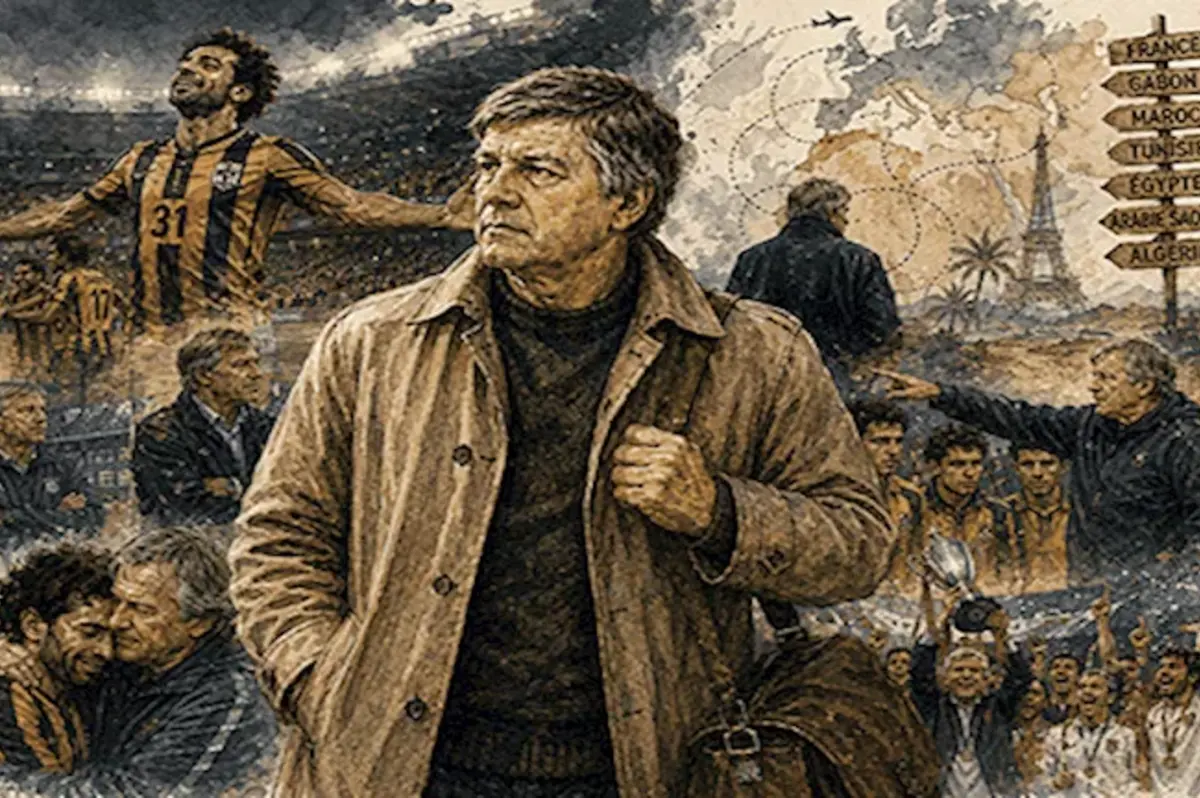
Cairo, December 25, 2010, Military College Stadium
A pass from the Arab Contractors midfielder, behind the Al-Ahly defenders, picks up the young player heading towards goal and he shoots it in to score the lead goal for the Mountain Wolves. The match commentator shouted: “The goal is against the flow of the match. Al-Ahly have the ball and the contractors are winning through their young player.”
The Mokawloon players were very happy and welcomed Salah.
French coach Ivika Todorov recalls: “Salah ran to me, fell into my arms and cried. At that time I felt goosebumps.”
It was not the only moment that the French coach has not forgotten. What was waiting for the young player, no one came.
From Nagrig to Arab contractors
Mohamed Salah played football on the streets of Nagrig, Gharbia, before joining Club Basioun for two or three years. He said in a television interview on the “Modern Sports” channel: “I played at the age of 12, then I played at Tanta Mokawloon, then at Arab Mokawloon.”
From Nagrig to Cairo, his father picks him up at 10 in the morning and returns at the same time in the evening, more than 4 times a week. Salah said: “Sometimes I would go out at dawn if I had a match and come back at 8pm.”
On November 8, 2010, Arab contractors appointed Frenchman Ivika Todrov as the coach of the first team. After the dismissal of Hamza El Gamal, the team was in last place (8 points) from 10 matches in the Egyptian Premier League.
Mountain Wolves youth team lost 1-0. The Frenchman was watching the match and told Masravi: “In the 16th minute, a young player came on, scored one goal and another. Sixteen minutes later, he won. In the next match, I started him against Al-Ahly, he scored and the match ended 1-1, and this result was very important for us.”
The Frenchman along with Salah along with two other players, Mohamed Desuk and Mohamed Elneny. Todrov says: “I took them and after that we did not lose a single match.”
The first step towards professionalism
In 2012, Zamalek refused to sign a contract with Salah. He said in an interview with “Modern Sport”: “Zamalek said that I will not play for Zamalek for a while. God was more generous and I came to Basel in Switzerland. I went, thank God and I hope I will never be a professional again and go to a big club.”
From Zrenanin in France
Todrov recalls: “I started my career at the Yugoslav club Proleter Zryanin, a club known for training players, and at the age of seventeen I became one of the youngest professional players, so a year later I moved to the Novi Sad club and played 3 years as a starter.”
The Frenchman recounts: “I was one of the biggest talents in Yugoslavia between the ages of fourteen and eighteen. I got carried away and it was my fault. I didn’t have enough patience to prove my talent.”
Proleter Zrenanin Club was founded on June 27, 1947 by the merger of three local clubs. It was then part of the Yugoslav football system in the Socialist Federal Republic of Yugoslavia and first reached the Yugoslav First League in 1967, before becoming Todorov’s first stop at the start of his professional career.
At that point, soccer was the most popular game in Yugoslavia, and the game itself was undergoing a transformation with the expansion of professionalism. In the early 1970s, first- and second-tier clubs became more closely linked to finance and commercial considerations, and the movement of Yugoslav footballers to Western Europe expanded.
The migration of players coincided with the economic and social transformation Yugoslavia was witnessing after the reforms of the mid-1960s, with labor migration expanding to Western Europe, with around 300 Yugoslav players playing abroad.
Todrov says: “We loved our country, we were proud to be Yugoslavia, and in football we were called the Brazil of Europe. For us, matches and training were war, but with a smile.”
Todrov was called by Milian Miljanic to Red Star. He told Masravi: “It was difficult to play as a starter because the team was going through a very good period.”
Todrov’s career could be turned around after a match against the Yugoslavian team for the Novi Sad club, in which he put in an excellent performance and was named man of the match. He recounts: “Vojvodina coach Pushkov contacted me to sign me, but the Proleter club refused. I was called up for a year of military service and at the age of twenty-five I went to France to start a new phase, in which a former Proleter player helped me move to the Limoges club.”
“When a Yugoslav would come to France, he would look for a way to bring a friend with him,” he recalls. “We were very supportive of each other.”
He continues: “Then another player helped me. He found me a club in Brittany and there, at the age of 28, I became a player and coach.”
When Todrov arrived in France in the late 1970s, French society was undergoing economic and social transformation; The number of immigrants and foreign workers has increased. On the other hand, football is reorganizing professionalism. After the players’ strike in 1972, the Professional Football Charter was approved in 1973, regulating the status of players, their contracts and their training.
French clubs reopened their doors to foreign players from 1966 and became one of the most important destinations for foreign players, including Yugoslavia, as 106 Yugoslav players played in the two French professional divisions between 1969 and 1978.
“At the age of 30, I started coaching professionally at the Stade Francis in Paris, after that I coached Brest, and then Lyon Ladocher,” recalls Todrov.
Todrov returned to Limoges in France as coach in the 1985-86 season and pulled off a surprise by knocking Nantes out of the French Cup on penalties.
He recalls: “In my career, I often coached teams facing difficulties. I never failed. I was called the doctor of sick teams. I traveled from France to Gabon in Africa.”
Sick team doctor
Gabon was his first stop in Africa. Todorov did not retain many details of this experience in his memory, but he remembers it as the beginning of a new phase in his career before returning to France and then again traveling to Africa via Morocco.
The Frenchman’s first stop in Morocco was with the Salé Association in the 1995–96 season, then he moved to Morocco’s Fez the following season and led the team to promotion to the first division in the 1996–97 season after finishing in the second division.
“When I promoted Mogreb Fez to the first division, there were thousands of fans crying with joy in the streets,” recalls Todorov. “They threw me in a fountain in the center of town. It was a wonderful adventure.”
The rise of Morocco-Fez was not the only thing in Todrov’s memory, as he says: “In Morocco, the passion was greater. I wasn’t looking for big and fast players. I was looking for talent. A talented player progresses faster and I managed to discover 27 players who became professional players or national team players.”
The following season, Todorov moved to Kawkab Marrakesh and the team finished the season in second place in the Moroccan league.
He then moved to FUS Rabat where he coached between 1998 and 2000 before leaving Morocco for a new experience in the Gulf.
After the capture of Rabat, Todorov left Morocco for the Emirates, where he coached Al-Ahly in Dubai for the second half of the 1999-2000 season, before moving to Saudi Arabia to coach Al-Shabaab the following season.
After his experience in Saudi Arabia, Todorov returned to North Africa, via Tunisia, where he took up the post of coach of Etoile du Sahel in the summer of 2002, before the experience ended in November of that year.
He then returned to Morocco again, taking over as coach of Wydad Casablanca in July 2003 and leading the team to the semi-finals of the African Cup Winners’ Club Cup, but lost the first match with two unanswered goals to Tunisia’s Etoile du Sahel and then a goal in Casablanca to bow out of the tournament.
Africa’s exit was not only the end of the story, but the beginning of another crisis. Wydad’s results in the league were not convincing. After nine games, the team managed only three victories, and fans and members of the board of directors began to demand Todorov’s departure.
He recalls: “I spent 12 years in Morocco, it was the period of my greatest passion and in Tunisia I achieved good results with Esperance and Etoile du Sahel and I enjoyed it because it is a great tourist country.”
Todrov found his greatest passion in Africa. He moved from Gabon to Burkina Faso and then to Congo. He told Masrawi: “Talents are mushrooming in Africa. They need training and motivation and the desire to succeed. I am proud to share my passion with young African footballers because I saw the desire to succeed in their eyes.”
He recounts: “Congo was very exciting for me because I had to find and develop unknown players. Fortunately, they had a very good mentality. The young people I discovered became professionals and famous, such as; Dunyama, Oninga and Ndinga. They had a great desire to develop. Thanks to them, I lived unforgettable moments in the development of players.”
From Africa to Egypt
After a long journey between Arab clubs and African teams, the Frenchman says: “I change clubs, cities, countries and continents and I am enriched by it. Thanks to Africa, I am African”.
Todrov arrived in Egypt in 2010. He says: “Egypt is something else. Big stadiums, good fans, high level players, respected officials. I only have medical memories. I regret that I only stayed for one year.”
Todrov’s arrival in Egypt was no coincidence as he was appointed coach of the Arab contractors based on his experience in the Middle East and North Africa and the ability to bring a team from the bottom of the league.
Todrov was not satisfied with the goal scored by Salah in Al-Ahly. He recalls, “My translator, Hassan, in Egypt, stayed with Salah and me to work on the finishing touches. After 5 weeks, his progress was obvious and he still wanted more. He was asking, ‘What else can we do?'”
Todrov believes that talent is judged from the stands. He says: “If you want to judge a player’s talent, put yourself in the stands. When a player receives the ball, you shout ‘go left’, but the ball has already gone left. That’s talent. The rest develops with matches and repetition. The power of success is confidence.”
After his experience with Al-Mokawloon which ended on 15th April 2011, he went through Najran in Saudi Arabia and then returned to Africa with Mangasport in Gabon, then his last experience was with Algeria’s CS Belouizdad in 2017.
While Todorov gradually moved away from the field, Salah continued to rise; From Basel to Chelsea, then to Fiorentina and Roma, to Liverpool, where he created his legend.
Zerual is my greatest sorrow and Salah is my greatest joy
Today, 76-year-old Todorov sits in his home in France and watches from afar the player he saw before the world knew him. Regarding his move to Trabzonspor, he says: “After ten years of being one of the best players in the world, he went to Trabzonspor at the age of thirty-two. Unfortunately, he had a lot to offer to many clubs in Europe.”
After a long journey, Todorf admits: “All the teams I coached remain in my heart. My biggest sadness was the death of the young Moroccan Zakaria Zeroual and my greatest joy was Mohamed Salah.”
