

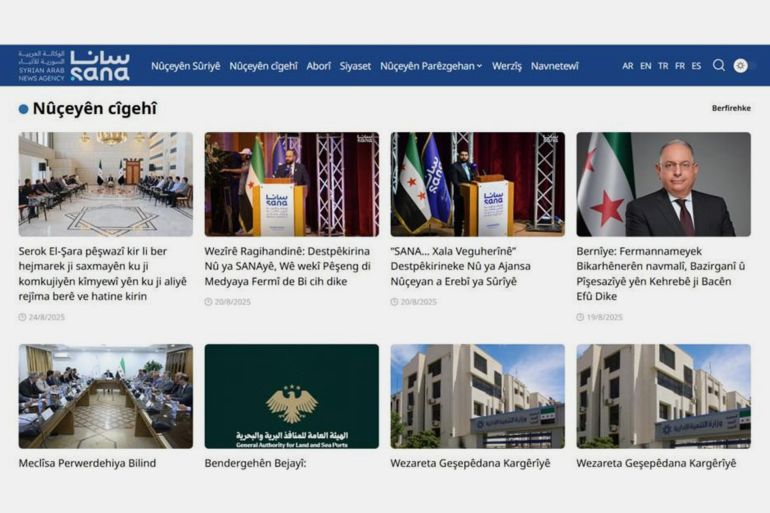
Damascus In an unprecedented move in the history of Syrian government media, the Syrian News Agency (SANA) has included Kurdish among the languages in which it publishes its content.
Observers believe the move represents a strategic shift in the agency’s orientation, an official recognition of the Kurdish people’s role in Syria, and an attempt by the government to reinforce a discourse of cultural pluralism given the history of marginalization and restriction that the Kurds suffered during decades of rule by the former Syrian regime.
Suggested stories
2 item listEnd of list
While others consider it an incomplete step due to the lack of a legal and constitutional regulator for it and the possibility of its repeal without any legal or political obstacles.
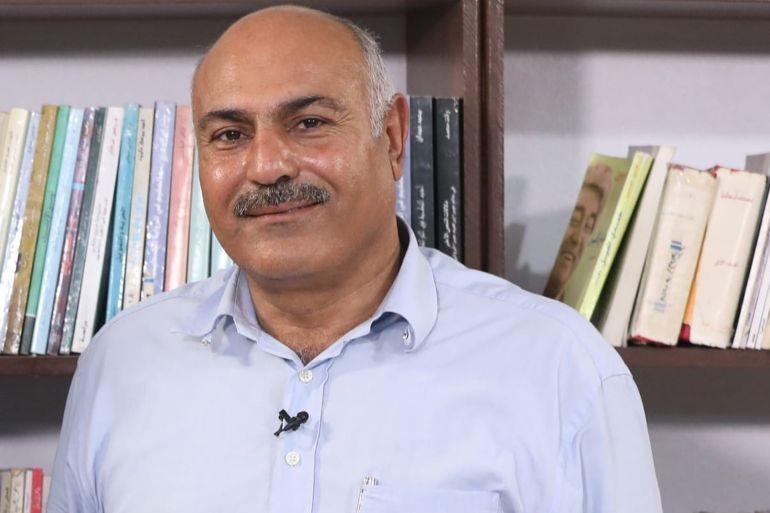
Narrator and writer Abbas Musa confirms to Al Jazeera Net: “The Syrian revolution, which has paid a heavy price in lives and missing people, deserves a lot of support. Syrians of all affiliations participated in the demand for freedom, pluralism and democracy.”
Great move
He characterizes the addition of the Kurdish language to SANA as “excellent, but it requires a package of decisions and changes. All official media should be multilingual. Multilingualism is a good step, but it is a minimal and insufficient set of rights.”
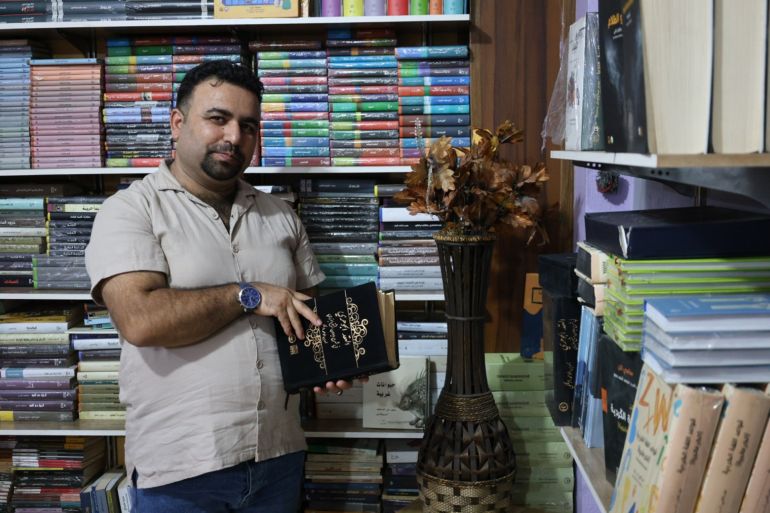
Meanwhile, Abdullah Arabi, a religious vocalist and muezzin at one of the Al-Hasakah mosques, recalled to Al Jazeera Net how Kurdish people faced threats and investigations from security branches, school principals or Baath Party delegates just because someone spoke their native language to a friend or perhaps a brother.
He added that “I am very optimistic and happy with this step, which confirms that the Kurds are part of the country and is evidence of a change in attitude towards them.”
Additional requirements
In a statement to Al Jazeera Net, Nafi Abdullah, a member of the Kurdistan Democratic Party’s Central Committee – Syria, criticized the Syrian government for the start of the country’s administration, saying: “It does not seriously care about the issues and rights of the constituents, be it political, linguistic or cultural.”
Abdullah relates the government’s approach to the language issue to the unfortunate events that the country has witnessed in recent months: “After the unrest and events in the Sahel and Suwayda region, the Syrian government has new calculations and a desire not to repeat these incidents.”
He calls the step of adding the Kurdish language to the Syrian News Agency positive. According to him, “We, in turn, encourage these trends. However, the Kurdish language should be officially recognized constitutionally as an official language in the Kurdish regions along with the Arabic language, and it should be taught in schools, institutes and universities.”
As for Walid Joly, a researcher at the Furat Center who is close to the autonomous administration, he told Al Jazeera Net that “the move does not go beyond the context of Kurdish demands. But it has no real meaning. Rather, it is a word of truth intended for lies.”
different positions
Nafi Abdullah believes that the current government wants to provide “a lot of flexibility to include components, and the issue of the adoption of the Kurdish people’s national language is one such trend, and it will often try to satisfy the components of the Syrian state.”
However, he asked for an assessment of the general situation, taking into account that the government and the country are facing many external pressures, which the constituents must effectively take into account and continue to demand cultural and linguistic rights.
Although Walid Joly believes that “the Syrian government is trying to be open to Kurdish rights and all components, but it is working on Kurdish rights without returning to the Kurdish political movement and that linguistic and identity pluralism should not be questioned”.
Official answer
In a conversation with Al Jazeera Net, the director of public relations of the Syrian News Agency, Muhammad al-Abdullah, linked “the patriotism of the official media and the ability to communicate with all components of the country in their language and style, emphasizing that broadcasting in the Kurdish language is a step towards a media that resembles the components of Syrian society and respects them.”
Al-Abdullah explains, “The issued decision confirms the constructive work with the Kurds, in practice and not only through speeches,” adding, “We have started forming teams of correspondents to talk to Kurdish guests inside and outside the country, based on professionalism and competence.”
Regarding the challenges facing the work, he said: “The infrastructure is too weak to train staff for the modernization of the editorial system. However, we believe that the proximity of the media to the people, and it listens to them, conveys their voice and talks to them, is the basis of the work of the national media.”
Division among Kurdish journalists
Al Jazeera Net journalist Olfa Haj Mansour is cautiously optimistic about the matter, saying “the addition of Kurdish to Sanaa news is a positive step that indicates tangible progress, especially as the Kurds form an essential part of the fabric of Syria and an important element in its geography and history.”
He added that “if we compare this move to the approach of the previous Syrian regime, which worked for a long time to marginalize the Kurds and tried to erase their language, culture and existence, this is undoubtedly a positive change towards the recognition of the Kurdish presence in Syria and the strengthening of communication between the components of the Syrian society.”
But he expresses his concern via Al Jazeera Net: “This step in itself does not mean solving the Kurdish question. The real solution lies in constitutionally recognizing the presence of Kurds and guaranteeing their full rights within the Syrian state.”
He says he fears that “the purpose of his inclusion is a policy cover that seeks to silence Kurdish demands for real political and constitutional change.”
As for journalist Abdul Hadi Sheikh, he said in an interview with Al Jazeera Net that “the addition of the Kurdish language is an unprecedented event in the official Syrian media, which has always opposed the use of any language other than Arabic. Therefore, the presence of Kurdish-language content is a tribute to the Kurds as an essential component of the Syrian fabric.”
He added: “This important step does not address basic constitutional rights, such as the full recognition of Kurdish rights in the Syrian constitution, and in light of the amendments to the constitutional declaration and the addition of legislation on the Kurdish language, this is only a media addition, not legal recognition.”
