
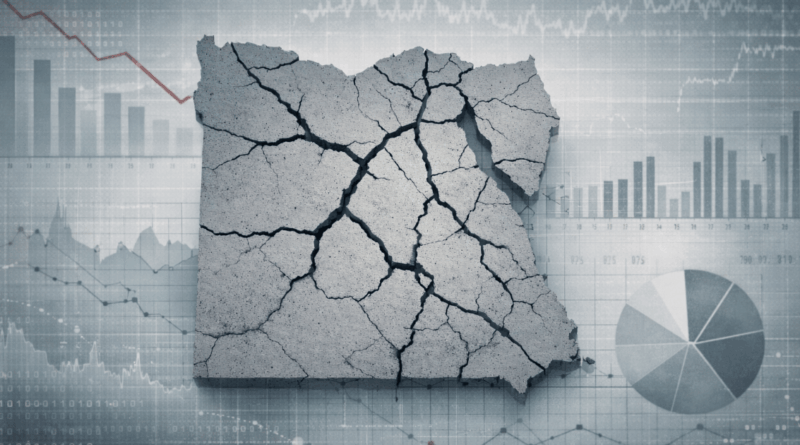
The failure state: multiple concepts and classification confusion
Posted on 5/1/2026
|
Last update: 1/6/2026 11:53 (Mecca time)
The term “failed state” is no longer just an academic description used in political studies. Moreover, in recent decades it has become a central concept in international discourse on which classifications are built, policies are shaped, and through which states are rearranged in the hierarchy of legitimacy and effectiveness. However, this dense existence of the concept did not lead to its clarity. Rather, it revealed a great deal of theoretical and methodological confusion and a persistent confusion between explanation and description, between symptoms and causes, and between failure as a structural condition and failure as a transient crisis.
The research from which we start here is called “Signs of Persistence and Change in Indicators of Failed States: An Analytical Study Applied to African Countries,” and is being conducted by Mahmoud Mohamed Osman Saleh, a MA researcher at the Department of Politics, Faculty of Commerce, Assiut University. He does not treat the “fallen state” as an ultimate truth or moral judgment, but as a problematic concept that arose in a particular political and cognitive context, and was then expanded and deployed in such a way that its connotations exceeded its explanatory power.
Also read
2 item listEnd of list
From Analytical Description to Classification Tool
In its early use, the concept of the failed state was associated with attempts to understand new patterns of instability after the Cold War, when inter-state wars declined and inter-state conflicts emerged. But the concept quickly moved from the realm of analysis to the realm of classification, and it was used to rank countries, prioritize support or intervention, and sometimes justify isolation or guardianship.
The problem is that this transformation has not been accompanied by solid theoretical agreement about the meaning of failure itself. Does the state fail because it has no security controls? Or because it does not develop its economy? Or is it because it is losing its political legitimacy? Or because its structural history has been dysfunctional since its inception? This question has remained open and has given rise to many interpretations, each with its own logic, but all of which have been applied under the same heading: “The Fallen State”.
Interpretation of safety: failure as loss of control
The most common interpretation is the security interpretation, which starts from the idea that the essence of the modern state is a monopoly on legitimate violence. According to this perspective, a state fails when it cannot control its territory, or when armed groups resist that control, or when internal violence becomes chronic.
This explanation seems intuitive at first glance, but it suffers from obvious reductionism. It equates conflict with failure, ignores the fact that many countries have experienced civil war and then rebuilt themselves, and does not accurately distinguish between total collapse and temporary security crises. However, this perspective has remained the most relevant in international discourse because it is the easiest to measure and the closest to the security concerns of great powers.
Institutional interpretation: a state that does not fulfill its functions
In contrast to the security approach, an explanation has emerged that focuses on the functional performance of the state. Failure here is not measured by the number of weapons, but by the state’s ability to provide basic services, manage its institutions, enforce the law, and fight corruption.
According to this perspective, the state may be stable in security, but it fails because it does not educate, treat, and manage its resources effectively. The strength of this definition lies in its comprehensiveness, but it in turn faces a conceptual problem: when does a weakness turn into a failure? Is every institutional failure evidence of state failure, or is it a matter of degrees and ways?
Economic explanation: failure as a failure of development
The third explanation relates the failure of the state to the inability to achieve sustainable economic development. In this context, a failed state is defined as one that is stuck in cycles of poverty, unable to create jobs, manage its resources, or withstand economic shocks.
However, the study draws attention to the dangers of this connection, as it can lead to hidden inequalities of poverty and failure. Not all poor countries are failed states, and economic history shows that development paths are not the same, and that subjecting the South to ready-made standards may be part of the problem, not the solution.
Political Interpretation: Crisis of Legitimacy to Crisis of Performance
Another interpretation takes us to the heart of the relationship between the state and society. Here, failure becomes essentially political, related to lack of legitimacy, blockage of channels of participation, and lack of trust between the ruler and the governed. The state, according to this perspective, fails when it rules by force alone, or when it loses its ability to represent its society.
The advantage of this interpretation is that it restores a qualitative dimension, but it faces measurement difficulties and differences in cultural and political standards between societies, which make it vulnerable to politicization and selectivity.
Structural-historical interpretation: failure as a long road
Research suggests that many cases of so-called failure cannot be understood without going back in history. Artificial borders, colonial legacies and state-building that preceded nation-building are all factors that have contributed to fragile states since their inception.
According to this perspective, failure is not an accident but the result of a long course of structural deformation. However, relying exclusively on this interpretation may lead to a kind of determinism, as if some countries are forever doomed to fail, which the study warns against.
From Explanation to Enhancement: Complex Explanations
In an effort to overcome the limitations of one-sided explanations, complex approaches have emerged that integrate security, economics, politics, and history. But these approaches, despite their comprehensiveness, gave rise to a new problem: inflating indicators, mixing causes with results, and turning failure into a comprehensive description of all imbalances.
Here a paradox arises: the more indicators there are, the less the ability to accurately interpret, and the failed state becomes a loose concept that includes everything.
Adjacent classifications: fragility, fragility, and collapse
The study focuses on the need to distinguish between “failed state” and other concepts that are sometimes used synonymously, such as fragile state, weak state or failed state. Vulnerability refers to vulnerability to crisis, not necessarily failure. Weakness refers to limited capacity, not the absence of a state. Collapse is an extreme state that is qualitatively different from failure.
Confusion of these concepts not only leads to analytical errors, but also contributes to stereotyping of entire countries, especially in Africa.
Africa between reality and classification
The selection of the African continent in the study was not arbitrary. It is the continent that most often appears on the list of failures, but at the same time it is the most diverse in its experiences and ways. The results show that many African countries remain in tight positions within the indicators for many years, raising a fundamental question: does this reflect stability in reality or stability in measurement instruments?
Research tends towards a complex answer: there are real imbalances, but the indicators themselves reproduce the classification and make failure a fixed identity rather than a condition that can be changed.
Conclusion: A concept that needs dismantling, not generalization
What the research reveals, in essence, is that the “failed state” is not a unified reality, but rather a mirror of one’s own point of view. Each interpretation reflects an aspect of reality, but cannot fully encompass it. The danger is not in using the concept, but in treating it as a final decision or a ready-made political tool.
A state does not fail in one way, for one reason, and not necessarily forever. If the concept is not considered and the indicators built on it, the failed state discourse will remain part of the problem rather than the solution.
Full message
https://2cm.es/1hnIg