
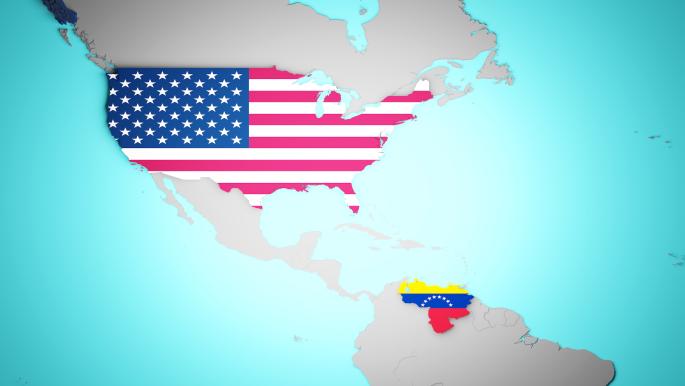
American messages from Venezuela to the world
What is happening in Venezuela goes beyond the future of the Latin American country, burdened by a long political and economic crisis, whose president was kidnapped from another country and tried there. Trump has put the world to the test of a new style of exercising American power: overthrowing an adversary, managing a vacuum, restructuring political institutions, then reopening the economy, before seizing a vast strategic resource. Therefore, the importance of the Venezuelan model is not only in what happens in Caracas, but also in the messages it sends to the world from Washington.
The Venezuelan model represents a significant shift in American thinking. In previous models, Washington aimed to topple a hostile regime, then left local forces to struggle to produce an alternative. But here the White House seems more involved in engineering the next stage: it deals with the interim government, supports a particular negotiating path, deals with a particular opposition delegation, and pursues the image of the institutions that will create the next dispensation. These ways are not just mediation between opponents. The mediator brings the parties together, while the dominant power determines (as America does) who the parties really are. Here’s the first message: The United States wants to influence the outcome of Venezuela, not just the transition process. This forces us to talk about democracy in the new American sense as a managed outcome rather than an independent path based on defining the conditions for its achievement. When an outside power chooses who represents the opposition, participates in controlling the political process, and keeps the electoral horizon open, the would-be democracy becomes vulnerable to a transition from the people’s sovereign right to an outside power-led transition. The real test will be when popular will clashes with American preferences. Only then will we know whether Washington is funding democracy or only funding democracy that suits its interests and is a partner in the arrangement. In this light, it is understandable how Venezuelan oil has become a necessary and necessary key to understanding all American politics.
Washington aimed to topple a hostile regime in Venezuela, then left local forces struggling to build an alternative
Trump’s announcement last August 28 of an agreement that would give the United States control of more than 65 billion barrels of Venezuelan oil reserves puts the economy at the center of American geopolitical strategy. The agreement, announced by Washington and confirmed by Caracas, aims to develop 17 areas, with private investment expected to reach $100 billion. The deeper meaning of this deal is that oil is no longer the economic reward that comes after political stability. It has become one of the components of the strategy by which stability itself is built. This is a very important change in the international system: when a country possesses enormous strategic resources, but experiences political and economic collapse, these resources can become an additional reason for the intervention of major powers to change its system. This has historically happened in Egypt, Syria, Iraq and elsewhere.
Trump is not presenting the new oil deal as a victory for Venezuelan democracy, but rather a deal that will increase US oil supplies, lower gasoline prices and boost US reserves. That is, foreign policy here is measured by a very realistic logic: what will the United States get? This is the essence of Trump’s rhetoric, based on achievements, alliances, sanctions, wars and negotiations. Even national recovery processes must bring tangible and direct benefits to the American citizen. For the sake of this vision, Washington declares, sometimes ambiguously and sometimes clearly, its willingness to use its political, military and economic weight to obtain better conditions for its interests, even if this requires redefining the relationship of countries with their resources and sovereignty.
The American message from Venezuela reads: We want countries that are independent on the outside, but they live in an architecture of influence shaped by American power.
In the Venezuela model, there is a new Trump philosophy based on Washington’s willingness to transform military power into long-term political and economic ownership. Here comes the importance of the oil deal, which the country’s interim president, Delsey Rodriguez, said will last for up to 25 years, in contrast to the American narrative that focuses on controlling resources and investment and rebuilding the industry. This model contains an American version developed out of traditional occupation and is based on determining the direction of authority, opening up the economy, guaranteeing resources and influencing the institutions that produce political legitimacy. Here comes the most dangerous question: Can Venezuela benefit from American power without turning into a country in America’s orbit? History tells us that countries that have fallen into this trap have not succeeded. To ensure failure, Washington never proposes to replace the ruling elite in Caracas. The signals from the White House that you can take away say: All we need is a change in the behavior and interests of the elites. If an old regime figure can provide stability, open the economy and secure new deals, he may be more useful to Washington than a radical and unpredictable opponent. This is precisely what complicates the Venezuelan issue more than Maduro’s duplicity against the opposition. Here is one of the most obvious paradoxes of the scene. Washington can talk about democracy while negotiating with figures who were part of the previous regime. He can support the opposition and at the same time choose who will be with him. He can call for state-building and at the same time push for the liberalization of the oil sector for American capital. These are not necessarily objections to the American decision maker; This is the pragmatism of Trump in transition, which aims to create a long-term economic and political arrangement.
There is also an American message that goes beyond Venezuela in everything that has happened and is happening. In the twenty-first century, sovereignty is not always won by tanks. It can be destroyed through debt, sanctions, investment agreements, restructuring of institutions, control of energy resources and dependence on security, so that the national decision itself becomes a series of obligations that are difficult to change. Venezuela has the largest proven oil reserves in the world, but has achieved production well below its historical potential due to years of mismanagement, lack of investment, sanctions and institutional collapse. The latest data points to production of about 1.16 million barrels per day in July 2026, compared to an increase in oil exports to the United States of about 786 thousand barrels per day. This paradox has a global lesson: resources alone do not create power, but a state that can control resources is what creates power. The message in this regard is clear for all countries that possess enormous wealth but suffer from weak institutions. Trump likes to tell others that he is the one who determines the terms of governance, and that sums up the entire Venezuelan model. American power in the age of Trump is not just telling countries: We can overthrow your governments; It says something deeper and more serious: we can participate in defining the image of the regime that is coming. We want outwardly independent countries, but they live in an architecture of influence shaped by American power. Place your desired flags and slogans above the presidential palace; A new state associated with Washington at the time of its establishment will be sufficient for us. Choose the president, the parliament, the government and the discourse of national sovereignty, but your main choice is related to the relationship with them, inevitably and ultimately, in the form of security, economic, energy and financial relations that have been formed during the transition period. This is the difference between controlling the land and controlling the conditions of movement on the land, as Trump wants.