
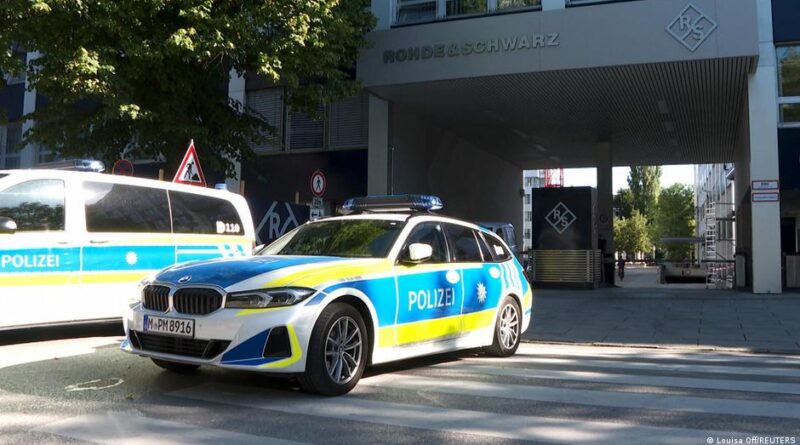
Germany: Suspicious attack involving two defense and security industry companies in Bavaria
September 3, 2026
“Possible political background” to attack on two defense industries in Bavaria.
The Interior Minister of the German state of Bavaria, Joachim Hermann, confirmed today, Thursday (September 3, 2026), that two companies in the defense and security industry were targeted. Herrmann said the incident was suspected to have a “political background” and stressed that the investigation was being handled by the anti-terrorist unit in the Bavarian capital, Munich.
The site is located near the Munich East train station and facilities belonging to the aircraft companies “Helsing” and “Rhode & Schwarz”. Helsing does not comment on the incident. Although technology company Rohde & Schwarz, which supplies equipment to the German army and other forces, confirmed in an interview with Agence France-Presse that it had found incendiary devices near its premises, adding that it was “not affected by the attack”.
It is believed that the incendiary devices were thrown from the car around midnight. An eyewitness saw the incident and reported it to the police, who started searching for the suspects.
Agence France-Presse, citing a police spokesman, reports that a 38-year-old Bulgarian man and a 28-year-old Bulgarian woman were arrested at a gas station in Munich as a result of the search.
“We face an increased risk of attacks on our infrastructure.
The incident came two days after suspected sabotage was reported at two German power plants hundreds of kilometers apart, and days after Berlin formally accused Russia of a failed attempt to attack Leipzig airport with an explosives-laden drone.
“Overall, this incident shows that, as has already happened in other parts of Germany in recent days, we now face an increased risk of attacks on our infrastructure, but also clearly on our country’s defense companies,” said Hermann of the Christian Social Union.
He continued: “We have to take these risks seriously and prepare for something like this to happen any day, anywhere else in Germany.”
https://p.dw.com/p/5L2T6
Published on September 3, 2026Last updated on September 3, 2026
Poll: Majority of Germans consider Russia a threat to their country’s security
The results of a recent poll in Germany showed that the majority of citizens consider Russia a threat to the country’s security, in light of the drone incidents and the war in Ukraine.
According to the results of the “Deutschland Trend”/Germany Trend/ poll conducted for the “ARD” network,… 56% of participants believe that the Federal Republic of Germany faces a strong or very strong threat from Russia. Instead, he expressed 39% of respondents believe that Russia poses little or no threat to Germany.
The results showed a marked difference in the views of German citizens on this issue in the western and eastern parts of the country. As long as he believes 59% of citizens of Western countries believe that Russia is a strong threat or a very strong threat to Germany’s security. This percentage does not exceed 42% only among citizens of Eastern states.
And when he sees 36% of the population of West Germany believes that Russia poses only a minor threat or no threat at all to national security. A percentage of those present reached this point 47% among the residents of the west of the country.
Infratest Demap Institute conducted its representative survey this time… 1319 A person entitled to vote, margin of error between two and three percent.
The survey was conducted from Monday to Wednesday. The German government’s announcement on Tuesday that Russian authorities were responsible for an attempted attack by a bomb-laden drone early last month prompted punitive measures against Moscow, with the Kremlin denying any involvement in the incident.
https://p.dw.com/p/5L2Oe
September 3, 2026
Germany will allocate an additional 250 million euros for the reform of Ukraine’s energy infrastructure
Germany’s Federal Ministry of Economic Affairs and Energy announced in a statement today, Thursday (September 3, 2026) that Germany intends to contribute additional sums… 250 One million euros to cover the costs of emergency repairs to Ukraine’s energy infrastructure.
The statement said that “this step is aimed at ensuring the supply of energy and heating to the population in Ukraine, despite the ongoing Russian attacks.”
The statement quoted German Economy Minister Katerina Reiche as saying: “Energy supply in particular remains one of the front lines of this war. We therefore support Ukraine in protecting and rebuilding its energy infrastructure and call on all international partners for further efforts.”
Germany intends to disburse these funds through the German Reconstruction Credit Bank (KFW), which is owned by the German government.
He added that Germany supports Ukraine in cooperation with the German business sector. “The donation of energy equipment provided by German companies has already made it possible to restore power to 1.4 million people. At the same time, we are working to attract private investment for reconstruction,” explained the minister, who belongs to Chancellor Friedrich Merz’s Christian Democratic Party.
The Ministry explained that four and a half years after the start of the war, the Energy Support Fund of Ukraine collected approximately 2.4 billion euros from international donors. With €810 million to date, Germany is the largest contributor to the fund. The Ministry of Economy added that KFW Bank actively supports the participation of German supplier companies.
https://p.dw.com/p/5L1pl
September 3, 2026
Germany criticizes Russia’s closure of the Goethe Institute and rejects comparisons with Berlin’s Russian House.
German Foreign Minister Johann Wadevoll expressed regret over Moscow’s closure of the Goethe Institute’s branches in Russia. The minister told the German News Agency (DPA) today, Thursday, in response to an inquiry regarding a meeting with French and Polish colleagues in the city of Weimar in the German state of Thuringia: “The Goethe Institute makes a significant contribution every day to the fruitful cultural relations and social exchange between Russia and Germany, despite the extremely difficult situation in Russia since the beginning of the Russian war.
Vadivul criticized the measure, saying: “In light of this, the measure now announced by the Russian Federation is very unfortunate, as it further damages our relations.”
Vadifoli visited the Weimar home of the late German poet Johann Wolfgang von Goethe with his French and Polish colleagues. The minister said that the closure of the Goethe Institutes announced by Russia is not justified, as the German government is responding to the attack on the Russian House in Berlin, which is clearly attributed to Russia.
Berlin has blamed Moscow for an attempted attack on Germany’s Leipzig/Halle airport with an explosives-laden plane on August 4. The German government announced a package of sanctions against Moscow the day before Tuesday. Russia denies any connection to the airport plane.
In this regard, the Minister of Foreign Affairs of Germany criticized that the house of Russia was no longer the so-called The worthy of the “House of Science and Culture” said: “I say very clearly: it does not serve culture or science,” adding that Russia should decide what kind of relationship it wants with Germany.
https://p.dw.com/p/5Kror
September 3, 2026
Moscow decides to close the Goethe Institute in response to the closing of the Russian House in Berlin
Russian Foreign Minister Sergei Lavrov announced today, Thursday (September 3, 2026), that the Russian government will close branches of the Goethe Institut, Germany’s international cultural institution, across the country.
Lavrov explained that the move was in response to Germany’s intention to close the “Russian House” in Berlin, Russian news agency Interfax reported.
The German government announced the closure of the Russian home after an explosives-laden drone was found at Leipzig airport. Berlin blamed Moscow for the attempted attack.
The Goethe Institute has its main branch in Russia, in the capital Moscow, in addition to cultural centers in St. Petersburg and Yekaterinburg. Speaking at the Eastern Economic Forum in the city of Vladivostok, Lavrov said: “Of course, it will be closed after the expulsion of our cultural center from there (Berlin).” He added that Germany realizes that the step it has taken against the Russian house means the end of its cultural presence in Russia.
Lavrov said that despite tensions with the West over the war against Ukraine, the institute was able to continue its work. It should be noted that the Goethe Institute is one of the last German institutes that still operated in Russia. Russia has made a large number of organizations and institutions “undesirable”, which means they have been completely banned from operating..
https://p.dw.com/p/5Kk1A