
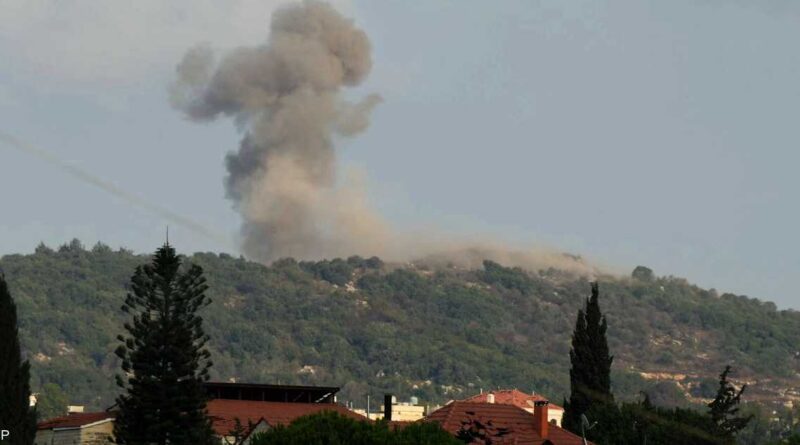
After Israel declared control over it… what is the significance of Ali al-Tahir Hill?
The hill, named after the Shiite cleric whose shrine is located at its summit, has been one of the most contested sites in Israel’s war against Lebanon, targeting Iran-backed Hezbollah, and has held strategic and symbolic importance in the conflict.
This chain of hills is not large in area, but what overlooks it in southern Lebanon, and what Hezbollah is believed to have established in and under its territory, has put it at the heart of the conflict with Israel.
where is it located
Ali al-Taher Hill is located about 15 kilometers from the Israeli border and enjoys a sweeping view over a wide area of southeastern Lebanon.
It was controlled by Israel during its occupation of southern Lebanon, which lasted 22 years and ended in 2000.
Since the start of the ongoing war on March 2, Israeli forces have penetrated deep into southern Lebanon and taken control of key hilltops, including the historic Beaufort Fort, located on the road to Ali al-Tahir.
In June last year, the Israeli army described the hill as “one of the main focal points of its operations” and included it in a map of the extended buffer zone it unilaterally declared where its forces are stationed.
The hill has effectively become a dividing line between the area of Lebanese territory occupied by Israeli forces to the south, and towns to the north that have been heavily bombed by Israeli airstrikes, including Nabatieh.
Why is it of strategic importance?
Lebanese security sources told Reuters last July that Hezbollah had allegedly built an underground command center and weapons depots on the hill itself.
According to analysts, the hill gives the party the ability to launch short-range rockets and drones in the direction of northern Israel, thanks to its height of 600 meters above sea level.
The Ali al-Taher hill also connects southern Lebanon’s border areas with the mountainous Iqlim al-Tufah region to the north, long considered Hezbollah’s main logistical and operational base.
The Israeli Air Force has launched an intensive offensive on the hill in recent months.
Last June, an Israeli military official, who requested anonymity, told Reuters that Hezbollah fighters were trapped underground without food or water.
The Times of Israel reported, based on a military investigation, on June 20 that an Israeli soldier was killed and 13 wounded while taking control of a key Hezbollah facility under the hill.
Hezbollah said that Israel was trying to advance, but that its fighters still had full control of the area and that they were ready to confront any attempt by Israeli forces to advance or penetrate.
In July, Israel’s military said it “will not allow Hezbollah terrorists to exit the underground terrorist infrastructure, operate in the area, or pose a threat” to Israeli soldiers.
What is political significance?
Ali al-Taher Hill is located near Zawtar al-Gharbiyya, a town from which Israeli forces were withdrawn in July as part of a US-brokered road map for the gradual withdrawal of Israeli troops from southern Lebanon in exchange for the disarmament of the Lebanese army to Hezbollah.
But because of Hezbollah’s refusal to lay down its arms and Israel’s announcement that it would not abandon the move, the plan was put on hold.
With Israel’s elections scheduled for next October approaching, control of the Ali al-Taher hill could be a gain that Prime Minister Benjamin Netanyahu’s government is trying to achieve.
Andrea Tennent, a strategic communications expert and former representative of the United Nations Interim Force in Lebanon (UNIFIL), said: “Before the elections, Israel needs a big victory in an area that has always been considered a Hezbollah stronghold.”
However, retired Lebanese military and political analyst Hassan June believes that Israel may prefer to impose a slow siege to avoid casualties among its forces.
Johny told Reuters that Israel is hesitant to launch an attack on Ali al-Taher Hill for fear of casualties, especially at this sensitive time before the elections.
But the Israeli army declared control of the Ali al-Taher hill, and Netanyahu said the area “no longer poses a threat to Israel.”
There has been no confirmation from Lebanon and Hezbollah has yet to comment.