

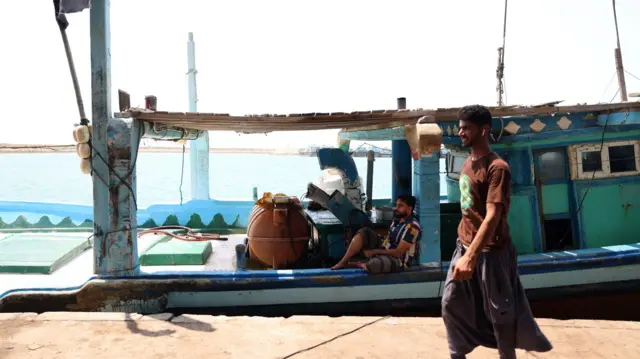
image source, AFP via Getty Images
was published
Reading time: 3 minutes
The secretary of Iran’s Supreme National Security Council, Mohsen Rezaei, said his country plans to establish a “restricted zone” outside the Strait of Hormuz in the coming days, Tehran’s latest move amid a military and economic standoff with the United States.
Rezaei told Iranian state television on Sunday that the area would start from the blockade line imposed by the US Navy and include parts of the Gulf.
He added that any ships entering the new zone would be placed on Iran’s “sanctions list,” without elaborating on the nature of the measures Tehran could take against ships that violate the restrictions.
Rezaei also said the Strait of Hormuz is “completely closed and under the control of Iran’s armed forces,” a characterization that contradicts the U.S. position that oil tankers continue to flow through the strategic waterway.
US Energy Secretary Chris Wright said on Sunday that more than nine million barrels of oil pass through the strait every day, adding that alternative delivery methods have increased flows to about two-thirds of levels seen before the current standoff.
Under normal circumstances, about a fifth of the world’s oil and liquid natural gas supplies pass through the Strait of Hormuz, causing any disruption to navigation in global energy markets.
Rezai’s comments come as the United States has stepped up pressure on Iran through a naval blockade targeting oil exports, in addition to tightening sanctions on it.
US Central Command said its forces struck three Iranian oil tankers on Saturday after Iran’s Revolutionary Guards fired ballistic missiles at two US Navy ships.
Iran’s parliament speaker, Mohammad Bagher Magnaf, warned on Sunday that any new attack on Iran’s interests and security would be met with what he called a “swifter, tougher and more painful” response.
The exchange of blows has resumed in recent weeks after military operations were scaled back for most of August, at a time when diplomatic efforts have made little progress to restore a ceasefire originally reached in June.
Economic pressures inside Iran
The military escalation coincides with economic pressures inside Iran, declining oil exports and difficulty accessing foreign currencies amid the US blockade and sanctions.
Iran’s government announced on Sunday that it will double the price of gasoline purchased with gas station cards starting September 8, while keeping subsidized ration prices unchanged.
Government spokeswoman Fatima Mohajerani announced that the price of a liter of gasoline purchased with station cards will increase from 50,000 riyals to 100,000 riyals.
Car owners will still be able to purchase 60 liters per month at 15,000 riyals per liter, in addition to 50 liters at 35,000 riyals, with personal fuel cards.
Fuel that exceeds this quota, or that is purchased by drivers without ID, is sold at a higher price with gas station cards.
Mohajerani said the increase in gasoline consumption has led to an imbalance between supply and demand and that the government is trying to increase production, expand public transport and encourage alternative fuels.
He added that 85 percent of Iranians can meet their gasoline needs within the subsidized monthly quota of 110 liters.
The government claims that the additional incomes obtained as a result of the price increase will be used for the livelihood of citizens.
Iran faces high inflation and sharp currency fluctuations, while the US embargo on oil exports has reduced one of the country’s most important sources of foreign exchange.
Washington says its campaign aims to pressure Tehran to allow freedom of navigation in the Strait of Hormuz and return to negotiations, while Iran accuses the United States of trying to strangle its economy and force it to make political and security concessions.
