
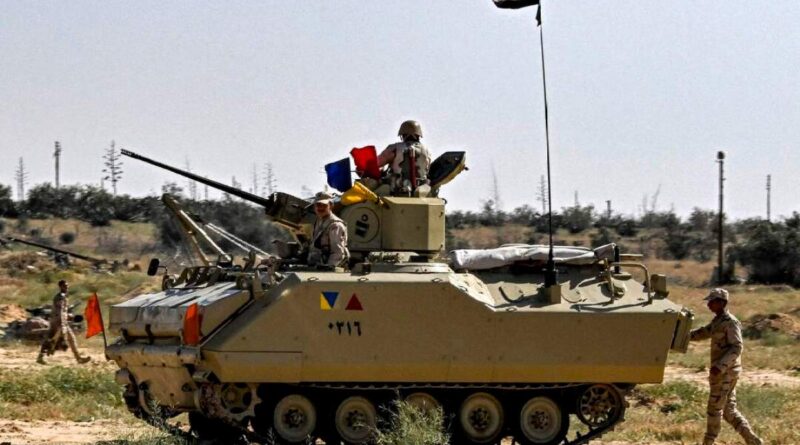
Military expert: Egypt’s support for Gulf states could include troops or armaments
Posted on 16/3/2026
An Egyptian military expert confirmed Cairo’s readiness to provide various types of support to the Gulf Arab states if they request it, and that Cairo has historically not been late in its role in protecting Arab national security.
Retired Major General Samir Farag, a military expert and former director of the Morale Department in Egypt’s armed forces, said in statements to Al Jazeera Mubasher that Egyptian President Abdel Fattah al-Sisi’s statement that “Gulf security is Egypt’s security” and the phrase “railway distance” reflect Cairo’s continued support for Arab countries’ readiness. By explaining to the country concerned that support can be military, logistical or intelligence and is not limited to sending combat forces.
He added that Egypt had recently made diplomatic efforts to ease tensions, noting that before the war, discussions were held in Cairo involving representatives of Iran and the International Atomic Energy Agency to discuss Iran’s nuclear program.
When asked if it is possible to send Egyptian forces to the Gulf, Farag said that Egypt has done so before in previous crises, stressing that military support is not limited to sending troops, but could also include providing Arab countries with weapons, ammunition, spare parts, intelligence information or military expertise.
He noted that the Egyptian army has great capabilities that allow it to provide this support and is considered one of the strongest in the region and has advanced naval and military capabilities.
A military expert confirmed that President Sisi’s recent statements were clear about Egypt’s willingness to meet any request for support from Arab countries, while Egyptian Foreign Minister Badr Abdel Atty is traveling to Gulf countries to consult on the unfolding crisis.
diplomatic option
Assessing the progress of the war, retired Major General Samir Faraj said that a diplomatic solution remains the best option to prevent the conflict from expanding, but he explained that the decision in this regard rests with the countries affected by the attacks.
He added that Egypt could play an important role in opening the way for negotiations between the United States and Iran, noting that Cairo has diplomatic relations and experience that allow it to act as a mediator at this stage.
Regarding the nature of regional threats, Faraj emphasized that Egypt believes that both Iranian and Israeli projects threaten Arab national security, noting that Iran has been trying to export its influence in the region since the start of the Islamic Revolution, while Israel, on the other hand, has expansionist ambitions.
He explained that Egypt considers these threats from the perspective of protecting its national security and therefore wants to maintain a delicate balance in its regional policy.
As for the length of the war, Farage said it would not last long, noting that its continuation would put great economic pressure on the United States and the world, and that the US administration faces domestic political challenges, including midterm elections and the difficulty of getting congressional approval for any large-scale ground intervention.
Farage noted that some international parties could benefit economically from the continuation of the war, such as Russia, whose gas prices have risen, but he believes Washington will ultimately try to find a political solution to the conflict.