
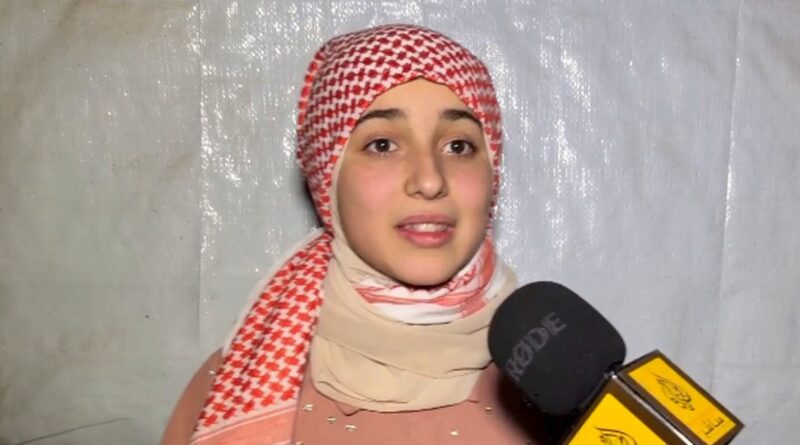
A Palestinian girl sings the praises of Abu Ubaydah with rousing poetic verses
Published on 9/1/2026
|
Last update: 23:19 (Mecca time)
In a dilapidated tent on the outskirts of Gaza, Palestinian girl Rahaf wears a red keffiyeh around her neck, not just to protect herself from the cold, but as a symbol of what meaning is left in a brutal life that has robbed her of her home and safety.
In a childlike voice weighed down by experience, Rahaf told Al Jazeera Live how the tents turned into rain traps and how the cold became an enemy that killed children, in a reality that no longer knew warmth and stability.
Rahaf spoke of nights inundated with water after the wind blew off the tent covers, the sandy ground that kept the cold out, and the insects that swarmed their lives in the makeshift shelter. He said that the simplest human rights and the simplest dreams of children have become unattainable and that Gaza no longer unites its people under one roof after the war divided them into martyrs, displaced persons and the lost.
In the midst of this harsh scene, Rahaf tries to lead by example and offer hope. When a reporter asked him to lift his keffiyeh over his face, he proudly said that he felt like Abu Ubaydah, whom he described as “the one who is not two” and who was the voice of hope that restored their confidence in their darkest moments. He added that his absence has left a great void, but his memory and words still linger in his mind.
Rahaf was not content with words, but composed poetic verses in which he mourned what he saw as a symbol and role model, and spoke in a voice that mingled sadness and pride, saying:
A man like a mountain, carelessly raises the flag
It stands tall, unshaken by bombardment, nor weakened by a trail of fire
The sound, if heard, will shake the creature of aggression
The echo echoed with fear and brokenness
Do you know who this strong man is?
Who is this steadfast in the face of the storm?
He is a masked commando… Abu Ubaydah
Abu Ubaydah is a symbol of patience when the siege gets tough
Really… really, the Gaza sky has lost its moon
When you were traveling with your Lord, the Forgiving
Rahaf says that Abu Ubaidah was the source that gave them hope when they thought that everything was destroyed, and that his voice gave them the good news that goodness has not stopped and tomorrow will bring something better, emphasizing that his words still remain in his memory, especially his famous phrase: “Either life that pleases a friend, or death that angers an enemy.”
At the end of the scene, another girl shared poems about attachment to the land, roots and patience, turning the tent, if only for a moment, into an arena of poetry and hope, against the backdrop of the reality of childhood and great loss for the children of Gaza.