

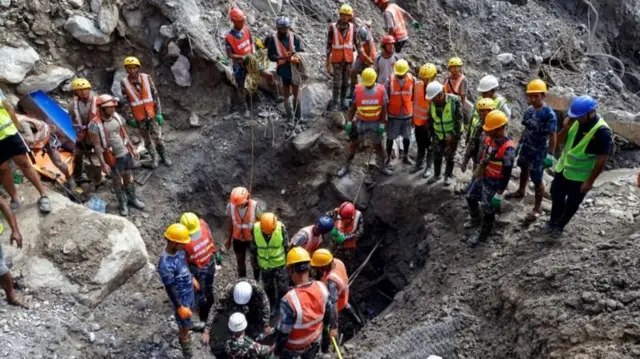
image source, Nepal Army Distribution/EPA
Rescuers in Nepal managed to pull out two workers alive after they were trapped in a power plant tunnel more than a week after floods hit the Himalayan region.
Rescuers later found the body of a third person. The director of the Nepal Electricity Authority told the BBC that the condition of his body has made it difficult to identify him.
Another 39 people are expected to be rescued after rescuers said they heard voices in the tunnel on Friday morning.
Local authorities told the BBC that two workers, who were airlifted to a hospital in the capital Kathmandu, suffered injuries to their arms and legs, apparently from climbing the tunnel.
The two workers were identified after their rescue as Sanjayah Saha and Kabir Maharjan.
The hydroelectric plants comprise an extensive network of tunnels that extend along the underground Trishul River.
It is likely that many of these dams were filled with silt after floods overtopped them and flooded the rivers.
Some workers were able to get out and more than 150 people are believed to be trapped in the tunnels of these stations.
“It’s like layers of miracles.”
I spoke with Arnold Dix, president of the International Association of Tunnels and Underground Spaces, who was advising the Nepalese government on the rescue.
He said: “I’ve never seen a rescue operation before. You had to find an entrance to a tunnel that was on top of a mountain and it became buried underground.”
He added: “You can imagine the size of the huge avalanche. It completely buried the entrance.”
Rescue teams were able to locate the excavation using satellite data and eventually found the entrance. The next challenge was finding survivors.
“We didn’t know where they were and we had to rely on our best judgment using technology,” Dix said.
Rescue teams were working inside the tunnel, which was completely blocked by mud and huge rocks, some larger than cars, and had to use explosives, “which we normally never do because of the risk of people dying in an explosion,” Dix said.
He added: “Then we found these two people. It was layer upon layer of miracles.”
Dix later said that rescuers were able to penetrate 60 meters into one of the tunnels, adding that there was 150 meters left in that tunnel.
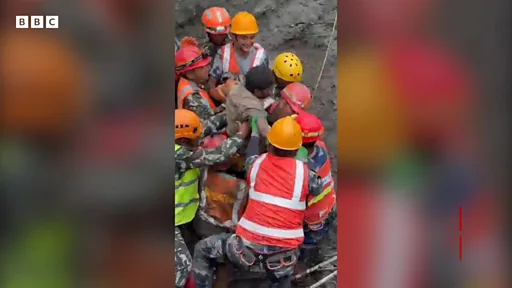
Following the announcement of the rescue of workers from inside the Trishuli 3I hydroelectric tunnel on Friday morning, Hiroshiwa, wife of worker Kabir Maharjan, expressed her great joy on hearing the news from the BBC in Nepal.
“I saw the pictures on Facebook. I was very happy. They are bringing me to the military hospital in Kathmandu. I am going to the hospital,” Hiroshiwa said.
He added: “We could not eat or drink well for ten days. We were very afraid. Now we are happy, we even cry.”
Kabir Maharjan’s brother, Amir, told Agence France-Presse after the announcement of his brother’s survival that he feels his heart is now lighter.
Reuters quoted an aide to the energy minister as saying Maharjan was moving his arms and legs, but the injuries of another worker, Sanjaya Saha, were not serious.
On Friday morning, the Nepalese government released images showing two workers being pulled out of the tunnel and placed on two stretchers.
Reuters reported that officials and rescue workers in Nepal believe that 900 people are believed to be trapped in the tunnels of six hydroelectric projects along the Trishuli River following an August 26 avalanche.
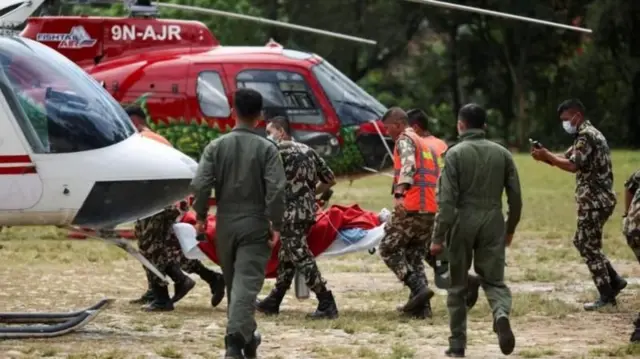
image source, Reuters
Agence France-Presse reported that by Friday, Nepalese authorities had found only a few bodies in tunnels flooded with water and mud after using explosives and bulldozers to open the passage.
He noted that rescue operations continue in a race against time and difficult geographical and climatic conditions, while drilling, bulldozing and blasting of rubble continue non-stop with the help of teams from China, India and South Korea trying to rescue workers trapped in power plant tunnels and dams under construction.
Nepal’s Communications Minister Bikram Timilsina thanked those who worked day and night to save the workers and expressed hope that others would be saved.
He said: “Efforts and prayers are continuing to save more and more survivors.”
Police have confirmed that 1,301 people have died and 5,339 are missing in the floods in Nepal and Tibet, including foreign nationals from 34 countries.
