

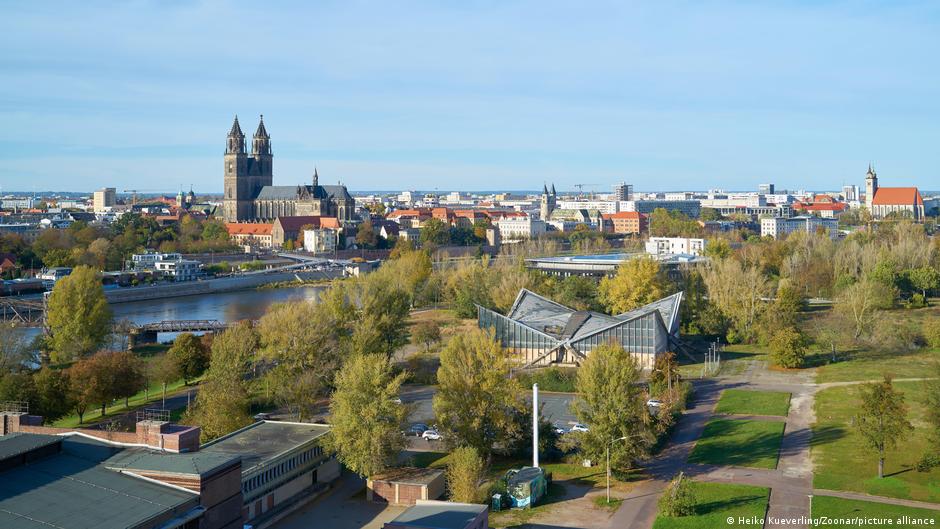
The state of Saxony-Anhalt is located in central Germany and has a long tradition. The world-renowned architects of the Bauhaus school in Dessau are from today’s Saxony-Anhalt region. In Eisleben and especially in Wittenberg, the memory of the great reformer Martin Luther is celebrated. It was here that he nailed his famous “95 Theses” to the door of the palace church, sparking a religious reform movement.
The “chemical triangle” in Saxony-Anhalt is located in the east of the state around the cities of Luna and Bitterfeld and still provides around 10,000 jobs today. To the west lies the medium-altitude range of the Harz. The European Elbe River flows through the state, coming from the east and heading north.
As for the south of the state, it will have to reinvent itself amid the structural transformation that followed the decision to abandon brown coal. Its unemployment rate is slightly higher than in Germany as a whole.
Saxony-Anhalt is a relatively sparsely populated state with a population of about 2.1 million people. Only two cities, the state capital Magdeburg and Hull, have more than 200,000 inhabitants.
However, in September 2026, the international media will focus on this small eastern German state: in Saxony-Anhalt, a candidate from a party classified by the Constitutional Protection Service as a “proven right-wing extremist” may become prime minister for the first time in post-World War II German history. The party Alternative for Germany (AfD), led by its main candidate Ulrich Sigmund, has a clear lead in all polls.
The Alternative for Germany party is leading the polls by a large margin
The AfD party in the state of Saxony-Anhalt received a support rating of 42 percent in a poll conducted by the ARD network a week before the election. The conservative Christian Democratic Union (CDU), which has governed the state for most of its time since its founding in 1990, is in last place with 22 percent.
The Regional Office for the Protection of the Constitution classifies the Alternative for Germany party as “proven right-wing extremist”, but this has not yet affected its support rating among the population. The left party has 11 percent in the polls, and the Social Democratic Party (SPD) has 8 percent. It is unclear whether the Green Party and the Liberal Democratic Party (FDP) will be able to enter the regional parliament. According to a recent poll by the first German television channel ARD, only the Green Party was able to enter the state parliament with 6 percent support.
The words of former CDU Prime Minister Rainer Hasloff are like a wake-up call. He announced in the summer of 2025 that he intended to leave the state if the party Alternative for Germany came to power. “I don’t want to live in a state where the AfD is in power,” Hazellof told the news magazine Spiegel at the time. The Alternative for Germany party currently holds 23 out of 97 seats in the regional parliament.
According to Haselof, he repeatedly felt in the regional parliament of Magdeburg that he was “sitting in the Reichstag during the last phase of the Weimar Republic, or later in the Berlin Sports Palace”.
The Weimar Republic was Germany’s first democratic state and ended with the Nazi takeover in 1933. At Berlin’s Sports Palace, Nazi Propaganda Minister Joseph Goebbels, a close associate of Adolf Hitler, declared “total war” in 1943.
In January 2026, Hasloff stepped down after 15 years in office, and his successor, Sven Schulz, must now challenge the AfD. If he fails, the long era of regional governments led by the Christian Democratic Party will end in September. Recently, the Conservatives govern together with the Social Democrats and the Liberal Democratic Party.
1994 Experience: Minority Government
From 1994 to 2002, the state of Saxony-Anhalt had made political headlines before: in July 1994, the Social Democrat Reinhard Hübner, who has since died, and the Green Party formed a minority government that tolerated the Social Democratic Party, the successor party to the Social Democratic Party that had governed the German Republic.
Cooperation with the heirs of the ruling party in the German Democratic Republic only five years after the fall of the wall separating the two German states: this was seen throughout the country, especially by conservatives, as a taboo violation.
1998: Success of the People’s Union Party extreme right
Later, until May 2002, Hübner governed alone without the Green Party, still relying on the votes of the Social Democratic Party. Soon there was talk of the “Magdeburg model”: the Social Democratic Party and later its successor, the Left Party, took part in taking over the governing responsibilities in other federal states as well. It was the state of Saxony-Anhalt that started it.
In Saxony-Anhalt, the tendency to vote for extremist parties was higher than in other regions of the country: in 1998, the German People’s Union, classified as a far-right party, entered the regional parliament with 12.9 percent. However, this group, suffering from severe divisions, refrained from re-contesting in the 2002 state elections.
How will the alternative party change the state?
Experts attribute the AfD’s high results in today’s polls to the great dissatisfaction of many residents of Saxony-Anhalt with the current situation in Germany. After reunification in 1989, many lost their jobs either in open-pit brown coal mines or in the chemical industry.
Many young people left the country and never returned. A large number of residents oppose continued immigration, even though the percentage of foreigners in the total population, which ranges from 8 to 9 percent, is well below the federal average.
Many observers believe that the example of the German People’s Union about 25 years ago shows that far-right groups in the state of Saxony-Anhalt have long established an electoral base that supports the current AfD, regardless of their election programs.
Political science expert Benjamin Hohn of the University of Chemnitz in Saxony told Radio Deutschlandfunk that he expects the AfD plans to restructure the constitutional system if it takes power in Saxony-Anhalt. Liberal norms based on the rule of law are systematically shaken: “I think the AfD is watching the situation in the US very closely at the moment.” In the United States, the government of President Donald Trump is following a similar path.
But Hun believes that it is difficult to implement such extremist programs in just one state: “It is impossible to turn the scale in just one state and then everything will go according to the far-right scenario.”
It seems certain: on September 6, the eyes of many people in Europe and the rest of the world will be on this small state of central Germany.
Prepared in Arabic by: M.A.M
