

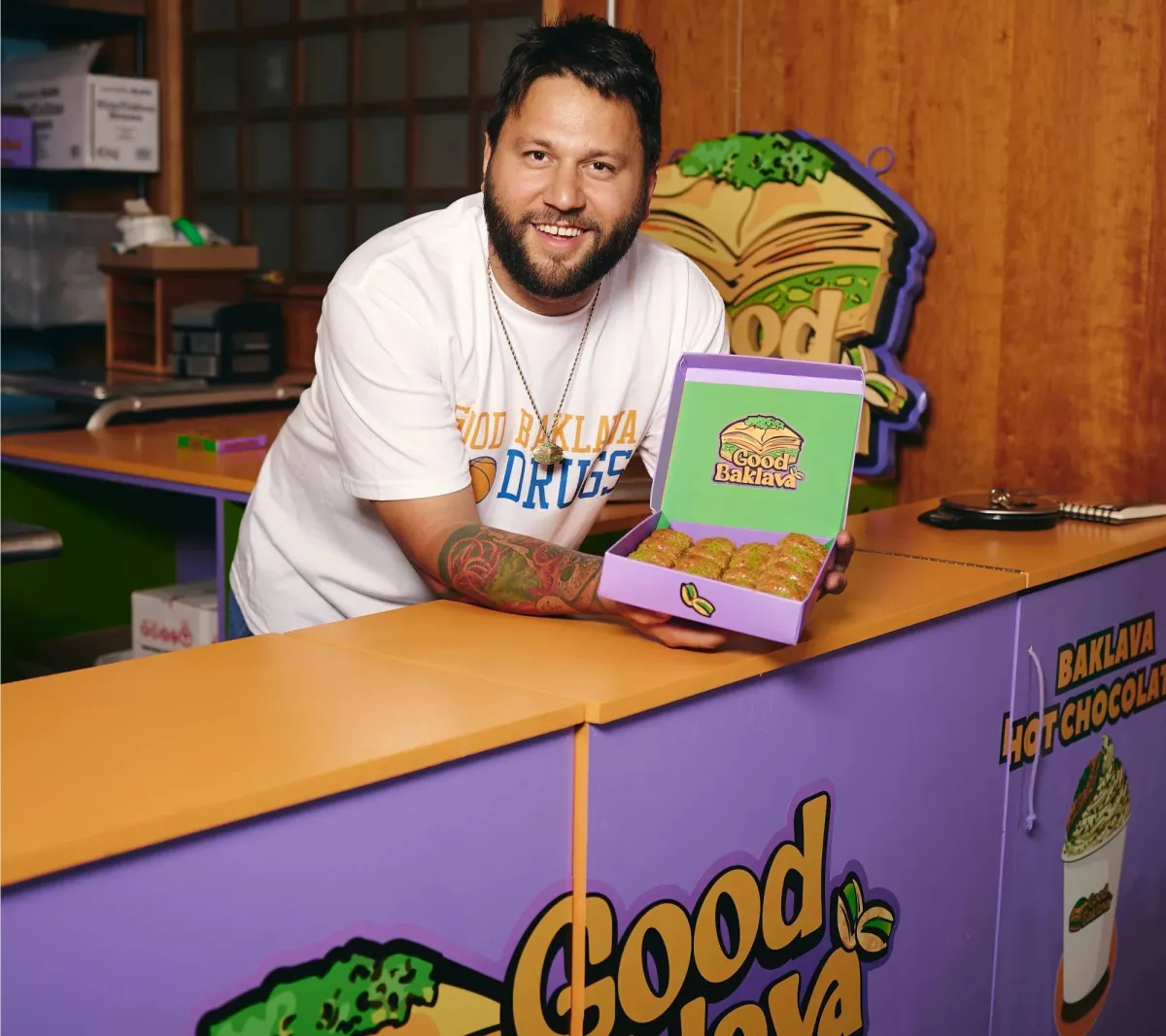
Jacob Komarov, a 30-year-old entrepreneur, left school early and previously struggled with drug addiction. But today he is known in New York as “Baklava Man”. He earns more than $20,000 a month and believes he has found his American dream in a multi-layered Turkish dessert.
According to a report published by CNBC, Komarov is behind the “Good Baklava” project, a mobile activity that sells baklava on the streets, from the back of a truck or through temporary stands, in addition to online orders. The project, which started 5 years ago, is experiencing an amazing wave of success thanks to the wide distribution on social media and unconventional sales methods.
The project doesn’t have a permanent store yet, so Komarov can be found on any given day selling his treats from city parks to music festivals.
In May and June, he also took to the streets around Madison Square Garden, serving New York Knicks baklava slices to New York Knicks fans to celebrate the team’s NBA championship run. Komarov imports baklava from a supplier in Gaziantep, Turkey.
“Baklava Man”…a professional name created by a comedian
Komarov is his legal name, but professionally he uses the name “Roy Dunk” on the Netflix comedy show I Think You Should Quit.
Komarov believes the Knicks’ success was a turning point in his project’s journey. After he posted video clips of it being spread outside Madison Square Garden, his accounts gained traction on social media before the New York Times published a report on him describing what he called “baklava fires.”
Komarov said that suddenly brands started approaching him for partnership. Since then, Good Baklava has partnered with local and national companies and restaurants.
He added that the project’s Instagram followers had increased by 20 percent overnight after the New York Times report, given that the project had just received the recognition it had been looking for for five years just by being present and celebrating with New Yorkers.
Monthly sales are over $20,000
The project is no longer satisfied with survival and continuation. Over the course of nine months, Good Baklava has averaged just over $20,000 in sales per month, according to documents reviewed by CNBC, with street sales, some temporary locations and delivery to local cafes and stores, in addition to online orders.
Komarov says he, like many, has been surprised at how far the project has come, adding, “It shouldn’t have gotten this far.” Therefore, it is the American dream.
A project that started as a joke and turned into a source of income
Komarov admits that the project started as a joke. In September 2021, while on his way to a Phish concert in California, he stopped at a Middle Eastern food store and spontaneously decided to buy 3 trays of ready-made baklava to sell to concertgoers and earn money.
He placed a bet on a friend who was skeptical about his number of sales and profits, but according to his account, he ended up tripling his money.
The move came at a time when Komarov was trying to rebuild his life. In 2021, he went 6 months without drugs and lost his “first real job” in e-marketing for a clothing company. He then moved on to freelance work in marketing and used the baklava project as a side source of income to help him continue.
For about 3 years, he bought trays of baklava and sold them at Fish Parties, before expanding to other outdoor events where large crowds gathered.
Today, he says he has spent more than five years in drug addiction recovery and is “grateful” for his new life.
Turkish baklava changed the way of his life
In the spring of 2022, Komarov bought a piece of pistachio baklava from a Turkish vendor in Paterson, New Jersey, and that moment was a turning point in his life. “I was amazed,” he says.
After he began buying from this vendor in large quantities, in 2024 he was able to connect with a supplier, a commercial bakery in Turkey, which now sends him monthly trays of unbaked baklava.
Komarov describes it as an “unlimited supply of baklava”.
“Convincing the audience is the key to closing the deal.”
Whether Komarov is in Prospect Park or Rockaway Beach in Brooklyn or in the parking lot of a Phish concert, he follows pretty much the same sales strategy.
He reaches out to people who weren’t expecting to be offered baklava in hopes of getting hungry, and carries a new tray of his products, while showing off a baklava tattoo he added to his arm in April 2022, a few months after selling his first slice.
Komarov likens his improvisational selling style to comedy shows that rely on direct interaction with the audience.
He says, “Winning the audience is closing the deal.”
It usually starts with a friendly introduction and a simple question: “Hello!” “Can I try to sell you some baklava?”
From there, he switches between friendly chats about the weather and other things, or opening his shirt to the phrase “good baklava; ‘no drugs,'” a phrase he coined after people started asking him if the baklava contained any drugs, especially at concerts.
“Baklava has become my whole life now,” he says. “This is the best candy in the world.”
