

Correspondents of Al Jazeera
Posted on 25/9/2023
|
Last update: 09:32 (Mecca time)
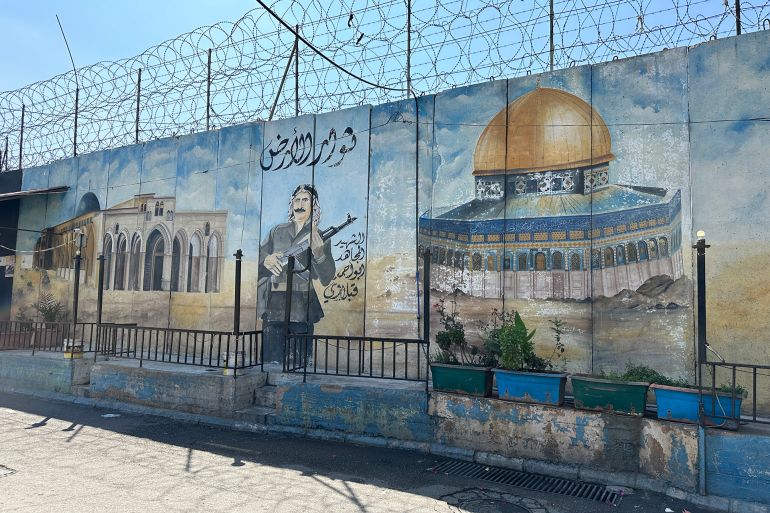
Ain al-Hilweh The destination was the city of Sidon, the capital of southern Lebanon, specifically a square kilometer surrounded by a 9-meter-high wall of barbed wire and inhabited by more than 85,000 people. Welcome to Ain al-Hilweh Palestinian Refugee Camp.
We enter the capital of the “Palestinian Diaspora” through its four entrances, which are controlled by the Lebanese army. From these entrances, only Lebanese and Palestinians in Lebanon (after presenting identification) are allowed to enter the camp, which was established in 1948 by the International Committee of the Red Cross to shelter Palestinian refugees after the Nakba.
Suggested stories
2 item listEnd of list
The camp was named “Ain al-Hilweh” in reference to the fresh water that was present when it was founded. It is leased from the United Nations Relief and Works Agency for Palestine Refugees (UNRWA) directly from the State of Lebanon for a period of 99 years.
“Zarub for one man”
We continue walking through the heart of the camp – located south of the city of Sidon and 67 kilometers from the border with occupied Palestine – which has been confined to its own territory for more than 7 decades amid constant population growth.
During our walk, we heard its residents complain about the narrow spaces between neighborhoods and neighborhoods, and saw houses stacked on top of each other and suffering from poor ventilation, humidity, and lack of sunlight.
Also, much of the camp area has become side alleys or what the camp calls “one man alleys” due to its narrow size and not wide enough for two people to pass together.
Due to this and other reasons, such as the lack of financial capacity and the high prices of renting or buying apartments outside the camp, many families have been forced to adopt the vertical construction style and abandon the “hakura” (very small garden) in order to take advantage of it by building one or more rooms to expand their houses or to house a married child.
The population of the camp increased as a result of several factors, the most prominent of which were:
- Relocation to the camp as a result of the Lebanese civil war,
- Destruction of the Tal al-Zaatar camp and the Israeli invasion in 1982.
- The destruction of the Nabataean camp, the war of the camps and the forced migration from the south,
- Adding communities attached to the camp, but not officially recognized by UNRWA.
According to the People’s Committees, its population is about 85,000, including more than 57,000 refugees registered with UNRWA, and there are 1,400 families classified as extreme poverty cases.
35 cities of Palestine in the camp
Camp residents belong to more than 35 cities and towns, and camp neighborhoods still bear the names of Palestinian villages and towns. What is remarkable about them is that their arrangement remains as consistent as it was in Palestine, as if they had come to the camp in miniature. It is the district of Taitaba, Akbara, Al-Safsaf and Arab Al-Zubaid and it is the neighborhood of Safuria, Al-Zeb, Hatin and others.
But this camp, which is spoken of as associated with clashes, killings, death and destruction, has not been like that since its inception. On the contrary, he played an important political and military role in the process of the Palestinian cause and many martyrs and wounded in the path of liberation of Palestine. However, for the past two decades, it has been bloody internal clashes between the Fatah movement on the one hand and Islamic forces and groups on the other, resulting in death, injury, destruction, displacement and the displacement of dozens of families from the camp.
Abu Ali Dahsha, who has lived in the camp since its inception, says that the people of the camp were one family, with solidarity and social interdependence, but the events in the camp separated people from each other, hoping that the clashes would stop, the problems between the warring parties would be resolved and the displaced would return to their homes.
He concluded with a wonderful wish: “Palestinians do not want to go back to the camp, but to Arab Palestine.”
As for Salah Awad, a resident of the camp, he explains how our people lived in tents when they came from Palestine during the days of the Nakba, then built their homes in the largest camp in Lebanon in the hope of returning to Palestine, and despite everything that happened and the camp was destroyed, especially the invasion of the mother of Israel and the gold we sold.
For us, the end of this camp is “strength and return to Palestine”.
In turn, the Palestinian journalist Abdel Halim Shihab says: “As a Palestinian refugee, I was born, grew up and studied in the Ayin al-Hilwe camp, the image of my camp changed a lot, because it was a model that combined the life of the shelter, which was imposed on our people, who left their land, with love for Palestine, but I did not live in my beautiful image. My father’s stories of that beautiful time about.
Shihabi, who still lives in the camp, added: “Considering the hard and harsh conditions we lived in and still live in today, the situation has changed in the camp. Yesterday the morning in the camp was full of the smell of coffee, the neighbors talked about life, politics and the main issue. But today the neighbor wakes up to separate the neighbor from the neighbor and separate him from the island. And the shadows that obscure each other’s vision are probably the cruelest things I have seen. Converting members of the same family, or people from the same neighborhood become enemies, carry guns and shoot.
He concluded: “My camp is no longer what it used to be. Yesterday it was a place of love and meeting, people united by the love of Palestine and the dream of return. Today I feel that the hope of return is a real threat.”
