

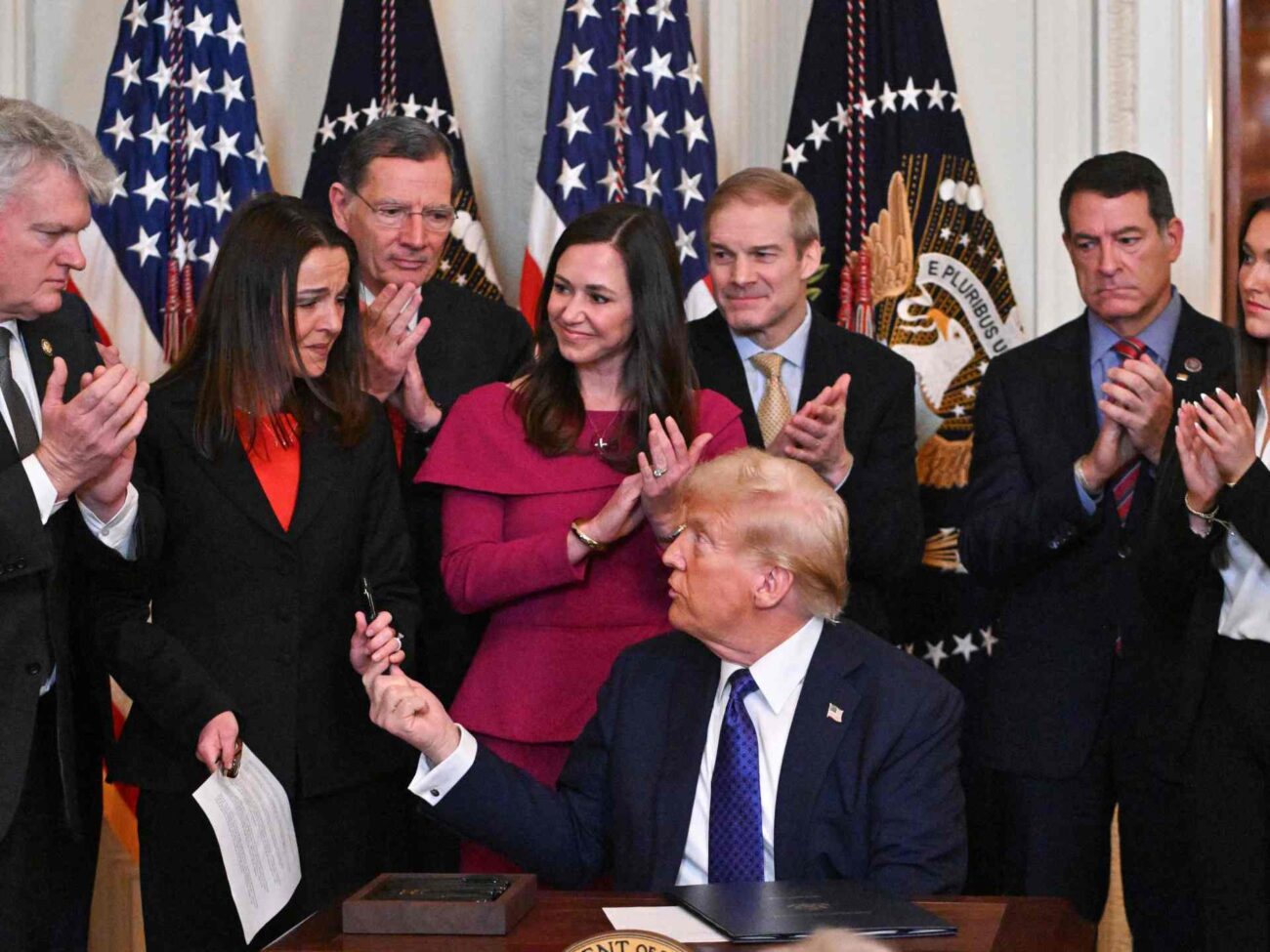
Washington – US President Donald Trump signed an executive order designating English as the official language of the United States, the first such designation in the history of the American country, which celebrates its 250th anniversary next year.
American government departments have always celebrated linguistic, racial and ethnic diversity, but the emergence of a right-wing populist trend that sees America as a white, Christian nation whose language is English has many worried about Trump’s increased acceptance of policies that benefit them.
Suggested stories
2 item listEnd of list
US House Democratic Leader Hakim Jeffries criticized the move, saying it might not survive legal challenges.
The order repeals a previous executive order signed by former President Bill Clinton that required government agencies to provide assistance to non-English speakers, but Trump authorized agencies to voluntarily maintain those language support systems.
In an Al Jazeera Q&A, we present the consequences of this decision on the lives of Americans:
Is it normal for each country to define its own official language?
Yes, it is estimated that more than 170 countries have an official language, some of which have more than one. Arab countries recognize the Arabic language as an official language, and some countries have a regional official language specific to a particular region, such as the Kurdish language in northern Iraq.
There are countries that have more than one official language. For example, Canada has two languages, English and French, while Switzerland has 4 official languages. According to Canada’s Official Languages Act of 1969, the purpose of the designation of two languages is to ensure “equality of status and protection of linguistic minorities, taking into account their different needs”.
What does it mean to make English the only official language?
This could lead to English being used as the only language in everyday government transactions and this would create a crisis for millions of people who do not speak English. This approach also reflects the White House’s perception of America’s white European Christian identity and denies the diversity that American society enjoys.
What is Trump’s logic for making English the official language of the United States?
President Trump has long supported efforts to promote the use of English only in the United States, and when he first sought the presidency in 2015, he mocked rival Jeb Bush, who sometimes answered questions in Spanish. “This is a country where we speak English, not Spanish,” Trump said.
The White House appears eager to fulfill another of Trump’s “America First” campaign promises, with the executive order saying, “A nationally defined language is at the heart of a united and cohesive society, and the United States is strengthened by citizens who can freely exchange ideas in a common language.”
After Trump signed the executive order, Charlie Kerry, a conservative political activist, wrote, “This is a huge step, in an age of mass immigration, to affirm that English as the official American language is a message of national unity.”
How consistent is this plan with Trump’s position on immigrants?
Trump has taken a tough stance on immigrants, especially undocumented, and his administration has launched massive campaigns to crack down on the illegal immigrant population and deport thousands more than has been the norm in recent years and decades.
The conservative movement, which supports the English-only initiative, is also believed to be motivated by hostility towards immigrants, their languages and cultures.
Is there anyone who doesn’t speak English in the United States?
Yes, there are millions of Americans who do not speak English. Some know English but prefer to speak in their native language, while others do not know English at all. Although more than three-quarters of Americans speak only English at home, or about 255 million people, about 85 million Americans (25% of Americans) prefer to speak another language at home.
What are the most common languages other than English in the United States?
According to the US Census Bureau, there are about 50 million Spanish speakers, followed by Chinese with about 4 million people, followed by Filipino, Arabic, and Vietnamese with about 2 million, and about 1 million people speak more than 25 languages, led by French, Korean, Russian, and German.
How will this move affect the daily lives of millions of Americans who speak languages other than English?
There is no direct or immediate impact on the lives of Americans. In places where immigrants are concentrated, it is natural and practical for everything to be bilingual, whether in public and educational institutions or in private institutions such as banks, restaurants or health centers.
In Chinatown, New York, San Francisco, Seattle, and other American cities, the use of Chinese is required in all establishments and stores, and you cannot succeed in these areas with English alone.
What are the main concerns about making English the only official language of the United States?
There are fears that the move will lead to government and public discrimination against non-English speakers, and supporters of immigrants see the move as inherently provocative because it is widely known that America speaks English and the move was not necessary.
Meanwhile, some immigrant advocacy groups say the order will hurt immigrant communities and those seeking help learning English.
House Minority Leader Hakim Jeffries said the order “like dozens of other executive orders and actions that have been taken, we have to look at whether what it does is actually consistent with American law and the Constitution, and if it’s not, I’m sure it’s going to be challenged in court.”
The decision also angered residents of the island of Puerto Rico, one of five US territories where 94% of the population speaks Spanish. Pablo José Hernández Rivera, a congressman from Puerto Rico, said, “The president’s order to declare English the only official language reflects a vision of American identity that is at odds with our Puerto Rican identity.”
What is the position of the American states regarding Trump’s decision?
English is already an official language in more than 30 states, including states with large populations where Spanish is their first language, such as California.
Trump’s decision is expected to encourage border states like Texas to adopt English as an official language, and there are fears that the policy will affect the translation of official state documents into languages other than English, or that those states will cut funding to hire Spanish-language teachers to work with immigrant children who do not speak English.
How does this decision affect the documents of federal government agencies?
It wouldn’t require changes to federal programs, but it would be a symbolic victory for the U.S. English-only nationalist populist movement associated with efforts to limit immigration and bilingual education.
Government agencies provide their documents in several languages, including Spanish, French, Filipino, Chinese, Arabic, Vietnamese, and others.
Many immigrants are wary of government agencies that justify ceasing to provide documents in languages other than English with the logic of saving huge costs in the translation and printing process.
Has any president tried to establish English as the official language of America before Trump?
In 1753, Benjamin Franklin, one of the founding fathers of the American nation, expressed concern that the growing population of German-born immigrants was making English a minority language, but he failed to make English an official language.
At the beginning of the 20th century, US President Theodore Roosevelt declared his belief that “we have room in this country for only one language, and that is English,” but he did not move to legalize it.
Republicans previously sought to classify English as an official language of the United States as members of the House of Representatives introduced legislation in 2021, but the proposal failed to become law.
What are the most visible dilemmas in the education sector?
Some advocates of the English-only movement want to end the bilingual education practiced by many public schools, so Trump’s decision raises the question of whether using or teaching languages other than English is illegal.
Many southern border states have bilingual education, English and Spanish, to deal with the children of immigrants from Mexico and Central American countries.
The percentage of students who speak Spanish exceeds their English-speaking counterparts in the states of Arizona, New Mexico, and large areas of Texas and California.
There is a fear of imposing discriminatory tests in the school system, especially in border countries where the percentage of Spanish speakers in some cases exceeds 50% of the students.
