

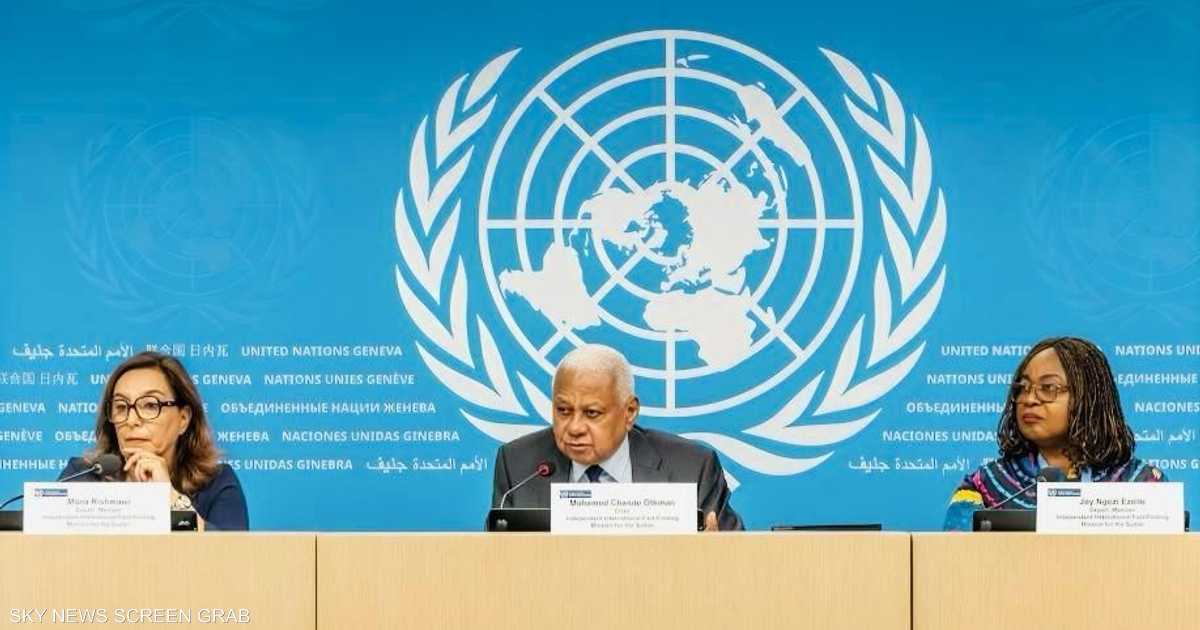
In a report released Thursday by the mission, which is scheduled to be presented to the sixty-third session of the Human Rights Council in Geneva, between September 7 and October 9, the Sudanese armed forces and its allied forces committed violations that could amount to war crimes.
He testified that the Rapid Support Force and its allied forces had also committed violations that could amount to war crimes, including murder, sexual violence, looting, forced displacement and ethnic attacks, some of which were more serious, particularly in Darfur.
The report identified the increasing role of foreign weapons, drones, foreign fighters and cross-border support networks in prolonging the war, and highlighted that the development of military capabilities on both sides of the conflict has expanded the targeting of civilian and vital objects.
The mission concluded that there are reasonable grounds to believe that the Sudanese Armed Forces and the Rapid Support Force committed serious violations of international humanitarian law and international human rights law during the drone operations and that some of the attacks carried out by both sides may constitute war crimes.
According to the report, airstrikes and drone attacks in the first five months of 2026 killed more than a thousand people and damaged hospitals, schools, markets, sites of displaced people and facilities providing basic services to civilians.
The mission warned that imported weapons and military technology did not bring Sudan any closer to ending the war, but instead gave both sides more opportunities to strike affected areas far from the front lines, widening the scope of civilian casualties and deepening the humanitarian crisis.
Army attacks on civilian objects
The report identified several attacks attributed to the Sudanese armed forces, including drone strikes that targeted or hit Al Dain Teaching Hospital, Abu Zaima Bazaar, Yabu Bazaar and other civilian targets.
He noted that at least 70 people were killed and 146 injured in the attack on El Dein Hospital in East Darfur State, besides rendering the hospital inoperable.
The mission confirmed that it had not found any information proving that the hospital was used to store weapons or to carry out attacks from it, explaining that the treatment of wounded members of the Rapid Support Force does not ignore the legal protection granted to hospitals, patients and medical workers.
The report states that there are reasonable grounds to believe that members of the armed forces have committed serious violations of international humanitarian law and that the deliberate targeting of civilian objects may constitute a war crime.
The mission also found that the army was using foreign-supplied drones in attacks that hit civilian targets, including the Yabus Market in the Blue Nile region.
The report indicated that some of the systems have characteristics consistent with foreign-made combat aircraft and mobile munitions, opening the door to investigating the sources of this equipment and how it entered Sudan.
An investigation into the sources of army armaments
The mission explained that its current investigation focuses mainly on external support networks linked to the Rapid Support Force, while the investigation into external support provided to the Sudanese armed forces is still at an early stage and the mission will report its findings at a later date.
He confirmed that he will expand this way in the coming period to determine the sources of weapons, drones and ammunition that reached the army, in addition to the nature and size of the support, its transport routes and its use.
The move is particularly important given the many reports that the military has been acquiring drones, weapons, ammunition and military technology from external sources and using some of them in attacks that have resulted in civilian casualties.
Expanding the investigation would hold accountable all external military supply chains, rather than just one country, and also allow tracking of companies, middlemen, shipping routes, airports and ports used to bring weapons into the country.
The report described the extensive network working for the Rapid Support Force, which includes individuals, companies, intermediaries and private individuals operating in a number of countries who provide weapons, equipment, logistics services, training and foreign fighters.
He pointed to the roles assigned to individuals, private individuals and cross-border commercial and logistics networks and called on the countries concerned to strengthen supervision and investigation of activities that may be carried out from their territories or through companies registered there.
Cooperate with the investigation
The mission said it had received cooperation from three countries, namely the United Arab Emirates, Chad and Colombia, which included answers to its questions and information related to the issues raised in the investigation, while no substantive response had been received from the other countries.
The mission noted the UAE’s cooperation with it and noted that it had received written and oral responses from the emirate and that two meetings had been held with state officials on 26 February and 19 June 2026.
He expressed his appreciation for this cooperation and welcomed the UAE authorities’ commitment to comply with international law, regulate the activities of private parties and hold accountable those responsible for any illegal conduct.
The report examined the UAE’s laws and procedures governing arms transfers, the activities of private security companies, anti-money laundering, corporate criminal liability and international crimes.
The report also mentions steps taken by UAE authorities to investigate arms and military material transfers linked to support for the Sudanese armed forces, citing a network that UAE authorities busted in April 2025 attempting to smuggle military equipment and illegal weapons on private jets for the Sudanese army.
The mission’s report considers the incident as evidence of the existence of local mechanisms and institutional capacity to investigate actions that may be carried out from state territory, regardless of the benefit of the Sudanese side.
The report also discussed the humanitarian assistance provided by the UAE to war-affected civilians inside Sudan and refugees in neighboring countries, amid one of the world’s most complex humanitarian crises.
This cooperation is in stark contrast to the position of the Port Sudan administration, which the mission said did not cooperate, did not respond to requests for meetings, did not allow members to visit Sudan, and did not respond to the final draft of the report.
A comprehensive arms embargo
The fact-finding mission called on the UN Security Council to extend the arms embargo currently in place on Darfur to cover all of Sudan.
It also called on States to suspend the transfer of weapons, drones and their components and technical and military assistance when there is a substantial risk that they will be used to commit serious violations of international humanitarian law.
The generalization of the embargo, according to the report, would subject all arms flows to both sides of the war to international control and prevent the continued entry of arms under any political or legal cover.
The report places the war in Sudan in a wider context than the direct confrontation between the army and rapid support, as a conflict fueled by multiple networks of weapons, money, technology and foreign fighters.
It also presents a picture that is different from the narrative that limits responsibility to one side because it confirms the serious violations committed by both sides and calls for a comprehensive investigation into the sources of their weapons and the accountability of the individuals, companies and intermediaries involved in the war, regardless of the countries from which they operate or the Sudanese entities that benefit from their actions.
The report states that ending the suffering of civilians requires all external support avenues, extending the arms embargo and ensuring that military technology and drones are not used to attack hospitals, markets, schools and places of movement.
In doing so, the mission’s report moves the foreign interference file from a circuit of bilateral political accusations to a path based on surveillance networks, entities, chains of ownership and verified evidence, in parallel with the next phase of opening a broader investigation into the sources of arms for the military and its external backers.
