
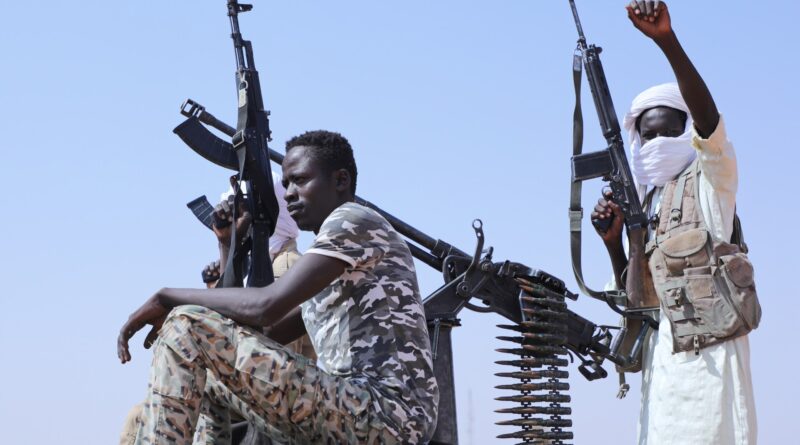
UN report on Sudan: US calls for arms embargo, UAE confirms neutrality
Published on 5/9/2026
|
Last update: 01:27 (Mecca time)
A UN report that revealed cross-border networks supplying Rapid Support Forces with combatants, weapons, training and logistical support has sparked reactions to the sources of this support, its routes and its role in strengthening Rapid Support capabilities and prolonging the war.
While the United Arab Emirates has renewed its refusal to supply arms or equipment to any side in the war, stressing that it is not a party to the conflict, two senior US administration officials have called for a comprehensive arms embargo on all parts of Sudan, amid multiple channels of external support for the warring parties.
In this context, the United Arab Emirates reiterated that it is not a party to the ongoing war in Sudan, following the release of a UN report on Thursday on external support networks and their impact on the conflict, while two senior US administration officials called for a comprehensive arms embargo on all parts of Sudan to end the civil war.
In a statement, the UAE condemned “in the strongest possible terms” violations of international human rights law and international humanitarian law committed by the Sudanese Armed Forces and the Rapid Support Force, and denied that it had supplied any weapons or equipment to any side since the war began in April 2023.
UN report
The UN’s independent international fact-finding mission in Sudan said in a new report released on Thursday that the recruitment of foreign nationals is fueling the war in Sudan, strengthening the military capabilities of the parties to the conflict in the country and allowing them to carry out more sophisticated military operations with devastating consequences for civilians.
He added in a statement that his report, titled “The Escalation of Conflict in Sudan: Arms, Fighters and External Support Networks”, documents how foreign personnel have been recruited, trained and deployed by transnationals active in a number of countries to support Rapid Support Forces.
The report states: “There are reasonable grounds to believe that private organizations, logistics brokers and recruiters operating from countries including Colombia and the United Arab Emirates have used transit points in Chad, southeastern Libya and Bosaso, Somalia to facilitate the delivery of personnel, training, weapons and logistical support.”
Expert Mona Rishmav, a member of the fact-finding mission, said: “We discovered a series of transnational networks spanning several countries that provided rapid support forces with foreign personnel, training, weapons and logistical supplies.”
He added that “this support contributed to Rapid Support Force operations in Zamzam camp and later under the control of El Fasher, where the mission documented gross violations of human rights and international humanitarian law and international crimes, including conduct with characteristics of genocide.”
The UN mission also concluded that “there are reasonable grounds to believe that these attacks (carried out by Rapid Support in Kaloki, South Kordofan State, and by the Sudanese Army in El Daein Hospital, East Darfur State, with drone strikes and deaths) constitute serious violations of human rights and international humanitarian law.”
A comprehensive ban
In the same context, two prominent US administration officials called for a comprehensive arms embargo on all parts of Sudan to end the civil war, noting the involvement of many countries in the country’s ongoing civil war.
A joint article published by Foreign Policy by Michael Waltz, US ambassador to the United Nations, and Massad Boulou, US President Donald Trump’s senior adviser on Arab and African affairs, said foreign intervention helped prolong the war.
The joint article also indicated that more than 10 countries with different goals are providing some form of military support to the conflicting parties, bringing in mercenaries from far-flung areas, including Colombia, and supplying warring parties with drones, equipment, spare parts, money and field expertise.
“to the abyss”
Waltz and Pauls said in their article that Sudan has been sliding into the abyss for years and that the UN Security Council has a historic opportunity to fulfill its duty to the Sudanese people and fulfill its mission to end wars, maintain peace and protect human life.
The article states that Sudan is witnessing the worst humanitarian crisis in the world. More than 33 million people lack the basic necessities of life, and an estimated 19.5 million people – the vast majority of whom are women and children – face acute hunger. An estimated 9 million people were displaced from their homes and 4.5 million others fled the country, while the war claimed at least 150,000 lives.
The article criticized the United Nations arms embargo imposed by UN Resolution 1591 of 2005 on Sudan, which is limited to the Darfur region, indicating the expansion of fighting into new regions such as Kordofan and Blue Nile State.
The two officials added in their article: “However, it was the UN that failed to adapt. For more than 20 years, the Security Council has maintained the same geographic scope of the ban, while the battlefield has changed, its tools have evolved and the actors and suppliers have completely changed.”
They noted that the G7 – including the United States – had called on the UN Security Council to extend the scope of the arms embargo to all areas of Sudan.
Sudan’s war, which began in April 2023 following a power struggle between the army and the Rapid Support Force, has displaced more than 14 million people and left one of the world’s worst humanitarian crises.