
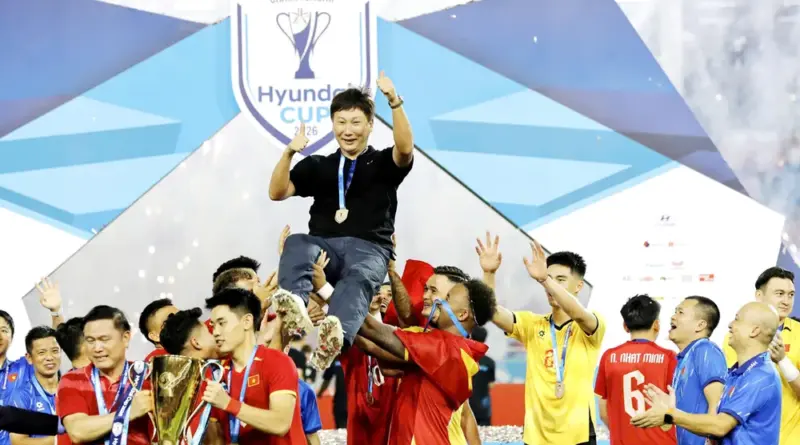
Vietnam football team has a chance to participate in the 2030 World Cup.
An opportunity that only comes once in a century
Despite strong opposition from Europe and North America, the expansion of the tournament is highly likely to be approved given the special nature of the Centenary World Cup, even if the expansion is limited to just one tournament. The 2030 World Cup will be hosted by Spain, Morocco and Portugal. However, Argentina, Paraguay and Uruguay will also host several matches to mark the tournament’s centenary. If the number of participating teams increases to 64, each of these countries will likely host at least one group stage.
The success of the first expanded 48-team tournament (in 2026) reinforces the viability of the plan, although FIFA faces unprecedented challenges in terms of the size and complexity of the event. If this is achieved, Asia is expected to receive an additional 4-5 places at the 2030 World Cup, bringing the total number of qualified teams from the continent to 12-13 teams.
For Vietnamese football, this is a once-in-a-century opportunity to realize the dream of the World Cup, especially since we are currently living in a “golden age” according to experts. The 2030 World Cup qualifiers are expected to start in late 2027, with Vietnamese football enjoying its best conditions in a decade. Coach Kim Sang Sik will have spent more than three years in charge of the team and will have a full understanding of the team’s strengths and weaknesses.
Since the national team won two consecutive AFC Cup titles, its core strength has matured in terms of players and age. The influx of naturalized players, previously a controversial topic, has helped strengthen the team. The under-23 generation is preparing to go to the highest division. The Vietnam Premier League shows remarkable stability in quality as investment continues steadily.
There are still many challenges.
The disparity in skill levels is the biggest obstacle facing Vietnamese football. Despite the fact that the Vietnamese national team was the leader in the ranking of Southeast Asian teams, it is still outside the list of the top 15 Asian teams according to the FIFA classification, and this classification, although relative, is not only a symbolic classification. Most of Vietnam’s direct competitors for the qualifiers come from West Asia, such as the United Arab Emirates, Syria, Bahrain and China.
All these countries have great advantages in football, in terms of physical structure, fitness and vast experience at continental level. The FIFA rankings can be relative, depending on the points cycle and the intensity of the matches, but they remain the criteria used by FIFA to determine the allocation of teams in the qualifiers – a factor that determines whether a team is placed in an easy or difficult group. Based on the current situation, Vietnam is likely to remain in the lower-ranked group.
Vietnam’s national football team needs comprehensive improvements in player quality, tactical thinking, physical fitness and on-field experience to close the gap in the two years remaining before qualification, which has been consistently accumulated in matches at a much higher level than the ASEAN Cup. These are the basic technical requirements to quickly raise the level of the national team without delaying the development process – from the coaching philosophy, competence of foreign coaches and long-term investment resources, to the stability of the Vietnam Super League.
A 64-team World Cup, if achieved, would expand the horizons of mid-tier countries like Vietnam. The history of world football shows that opportunities only come to countries that make constant and persistent efforts. There is no room for complacency.
Dang Lena
Source: https://thethao.sggp.org.vn/bong-da-viet-nam-co-co-hoi-gop-mat-o-world-cup-2030-post870251.html