

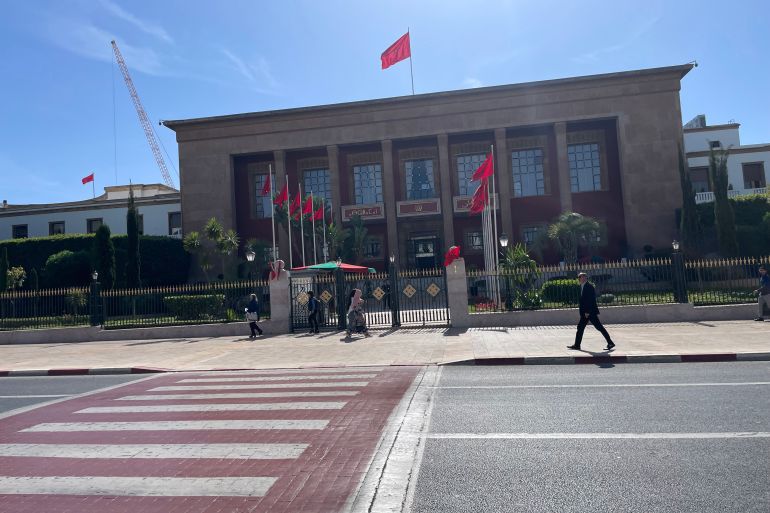
Rabat – On September 23, Moroccans will go to the polls to elect members of the House of Representatives in the 12th election in the country’s history since independence.
Competition is heating up among Moroccan parties to decide the political map in parliament for the next five years and the composition of the next government, amid challenges related to participation rates, especially among young people, ensuring the integrity of elections and “limiting the influence of political money and the influence of prominent and influential people”.
Suggested stories
2 item listEnd of list
In this report and by answering the following questions, we provide a comprehensive overview of the legislative elections in Morocco.
How many seats are contested in the House of Representatives and how are they apportioned?
Candidates are vying for 395 seats in the Chamber of Representatives (the first chamber of the Moroccan parliament). These seats are distributed among 305 local constituencies open to direct competition between all men and women, and 90 seats in regional constituencies are reserved for women.
What is the voting system used in parliamentary elections?
Morocco uses a system of direct universal suffrage based on list proportional representation, where each voter votes on a list submitted by a political party, including the names of pre-agreed candidates, led by someone known as a “list agent”.
The seats each party is entitled to are determined based on the “electoral quota” mechanism, which is calculated by dividing the total number of registered voters in the district by the number of seats allocated to it. Under this mechanism, each list that received a number of votes equal to this electoral denominator gets one seat, and the remaining seats are distributed according to the “largest remaining” rule.
This pattern ensures political pluralism in the parliament and allows different parties to gain representation in proportion to their electoral strength. It also prevents any one party from dominating the political scene.
How many people are registered in the electoral rolls and how is the voting process going?
The number of people registered in the final electoral lists reached 15.8 million people, including 391 thousand new voters, 54% of whom are men, and 46% are women.
Geographically, 55% of the voting block is in urban areas and 45% in rural areas. At the age group level, 29% of voters are over 60 years old, 21% of them are between 35 and 45 years old.
On the other hand, the youth group has a weak participation, as the percentage of those registered between the ages of 18 and 24 does not exceed 4% of the voting block.
Do Moroccan immigrants vote and how?
Although Moroccan immigrants were allowed to vote directly in elections and voting offices were opened in consulates and embassies in foreign countries, they still have not found their way to the light.
On the other hand, the law provides for a voting mechanism, as a Moroccan living abroad can authorize another person to vote at a voting office inside Morocco, and the Ministry of the Interior has adopted an electronic platform to carry out this proxy electronically.
When do election campaigns start and how are they financed?
The election campaign officially begins on Thursday, September 10 and continues until midnight on September 22 of the same month.
The state allocated 450 million dirhams (about 48 million dollars) to support the election campaigns of the candidates, as follows:
- 400 million dirhams (about $42.7 million) to support political party candidates.
- 50 million dirhams (about $5 million) to support regulations for independent youth under the age of 35.
The state is obliged to pay financial contributions to the parties in two parts, the first is distributed equally before the elections, and the second after their conclusion, and its value is determined in a variable manner depending on the results and the number of mandates obtained.
In addition to this public support, parties rely on their own resources, such as membership subscriptions and candidate contributions. The law sets a cap on election expenses of 600,000 dirhams (about $64,000) for each candidate, which obliges him to submit to the competent authorities a detailed statement of the sources of his campaign financing and the means of their disbursement.
How does the electoral system ensure the representation of women and youth?
In order to ensure a significant presence of women in the House of Representatives, the electoral system adopts the mechanism of “regional lists” intended only for women. The number of women in the outgoing council reached 96, 90 of them won seats on the regional list, and 6 on the local list.
New electoral laws have enacted incentives to encourage young people to join the House of Representatives by:
- Allowing the formation of independent lists beyond party endorsement.
- Simplification of candidacy submission procedures for young people under 35 years of age by reducing the number of signatures required for nominations of voters registered in electoral lists to at least 200 signatures.
- Allocation of public support covering 75% of election campaign expenses for this category of candidates.
Which political parties are the most prominent in the elections and what are the chances of each of them?
27 political parties are fighting for seats in the House of Representatives and the electoral map is divided between the two parties:
The expectation is that one of the ruling coalition parties will lead the election, while the focus is on the Justice and Development Party, which is expected to make a tangible advance in the number of parliamentary seats to compensate for the “declining sound” it suffered in the previous election, when its parliamentary bloc collapsed and it won only 13 seats after leading the government.
Who is prohibited from participating in the elections?
Electoral legislation has tightened eligibility requirements, particularly following the arrest, trial and conviction of a number of parliamentarians in corruption and drug-related cases.
Whereas in the past the ban on candidacy required a final court decision, the situation has changed for this election, as the ban now covers individuals who have been prosecuted if they have been caught committing a crime such as theft, fraud, treason or forgery.
It also includes those against whom preliminary and appellate judgments have been issued, or legally binding sentences of imprisonment and probation or removal from mandatory liability. In this case, the ban lasts for 10 years, which means two consecutive terms.
What are the most important challenges facing the September 23 elections?
Among the most visible challenges of the elections are those related to restoring the confidence of citizens, especially the youth, and overcoming the crisis of electoral aversion. Economic issues and erosion of purchasing power are putting pressure on parties to present realistic programs that are far from broad and unfulfilled promises.
These elections also face ensuring election integrity and curbing the influence of political money and limiting the “power of prominent and influential people,” as well as countering fake news and defamation in the digital space, which has become a major arena for political competition and vote-getting.
When are the results announced and how is the government formed after they are announced?
Morocco’s Ministry of the Interior, as the election’s supervisory body, publishes the results the day after the vote, on September 24, 2026, but they will not be final until the Constitutional Court rules on the appeals.
According to the 2011 constitution, the head of government is chosen from the leading party in the election, and it was a political custom for King Mohammed VI to choose the head of the party for this position.
The Prime Minister needs to form a parliamentary majority with at least 198 seats. Due to the nature of list voting and proportional representation, which prevents any party from gaining this majority, the Prime Minister upon his appointment begins consultations with the rest of the country’s political forces to form a government coalition that will guarantee this parliamentary majority.
