
What does it mean to create a parallel government in Western Sudan?
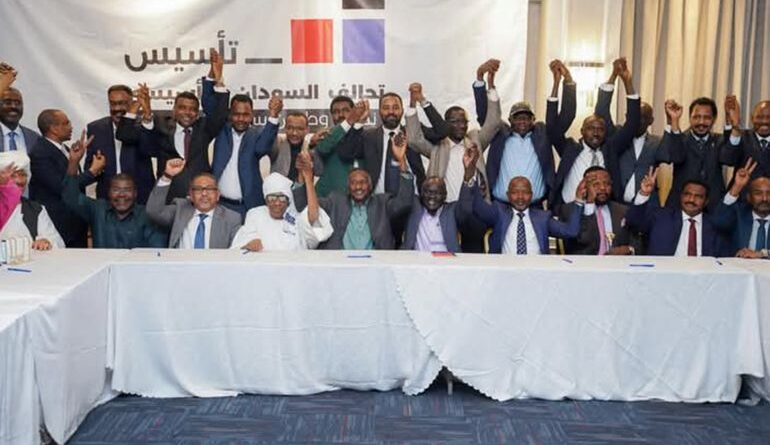
Khartoum- Five months after the founding of Sudan’s founding alliance, Taase, led by the Rapid Support Forces, the coalition announced the formation of a government in the territories it controls, making the scene in Sudan more difficult and dark and aiming to create a place for coalition factions at the political table, which is expected depending on the crisis in the country.
Last February, the Rapid Support Forces, political forces and armed movements, especially the SPLM-N, led by Abdel Aziz al-Hilu, signed a political charter in the Kenyan capital, Nairobi, to form a parallel government under the slogan “peace and unity”.
A month after the approval of the charter, the coalition factions signed a transitional constitution that stated that Sudan was a “secular, democratic, decentralized state with a Sudanese identity, based on the separation of religion from the state.”
Coalition spokesman Alaeddin Naqdi said in a statement from Nyala, the capital of South Darfur state.
Where is the influence of the parallel government fully established?
Rapid Support Force deployment areas were rapidly reduced after October 2024, the army liberated Senar State, then Gezira State, and completed control of Khartoum State, then North White Nile State, South Nile River, Blue Nile, and Southern North Kordofan State.
As for other states, Rapid Support Forces no longer exist except in North and West Kordofan states and South Kordofan and Blue Nile states, except for 4 of the five states in the Darfur region.
Where are the SPLM-N forces stationed, which is the second partner of the “Establishment” coalition?
After the secession of South Sudan from the north in 2011, the SPLM-N controls areas in the southwest of South Kordofan state, including Al-Baram, Umm Durin and Heiban. He took the fortified Kauda area in the heart of the mountains as his headquarters and base and established civil administrations in areas that live in poor humanitarian conditions and depend on foreign organizations for education and health.
What is the position of the Sudanese government and army regarding the new authority over RSF checkpoints?
Sudan’s Ministry of Foreign Affairs said it strongly condemns what the “quick support militia for terrorists” has done by declaring a “fake government” that claims to be handing over government positions to the administration of Sudan. He viewed his statement as “the best proof of his defeat and defeat by the armed forces on social media pages”.
He called on neighboring countries, the international community, regional and international organizations and all government bodies and organizations to condemn the statement and urged them not to recognize or deal with the “illegal organization declared by the militia” and considered “relations with the organization a violation of the Government of Sudan and its sovereignty over its entire territory”.
Sudan’s army spokesman Nabil Abdullah also said the alleged parallel government was a “pathetic attempt to legitimize a criminal project” and vowed to thwart its agenda.
Abdul said – in a statement – “The alleged militia government is an attempt to deceive even their partners into treason and the real project of the Daglo family is to seize power in order to achieve their illegal self-ambitions and racist project.”
For his part, the governor of the Darfur region, Mini Arko Minawi, commented – via the Facebook platform – that he did not find in the statement of the parallel government “anything new that requires comment, except that it includes the sharing of violations and the equal distribution of crimes between the Rapid Support militia and its allies”.
What is the parallel government’s priority for citizens in areas controlled by Rapid Support in the Darfur and Kordofan regions?
Mehdi Al-Hadi Dabke – Secretary General of the United Civil Forces Alliance “Qimam” and the leader of the Coalition “Tassa” – says that the “Government of Unity and Peace” can manage issues based on the experience of civilian administrations and that it has a clear program and plan to open political and diplomatic initiatives, both through international war and international war and world war.
Dabke explained in an interview with Al Jazeera Net that his government will print new currency, operate a banking system, issue passports, prepare a civil registry for all citizens, and work to return IDPs and refugees to their areas and compensate war victims.
Based on the experience of civil administrations of rapid support, are there resources that allow them to change the situation in favor of the citizen there?
Political researcher Mohamed Ala El-Din explains that Rapid Support Forces have established civilian administrations in 4 states of Darfur except West Kordofan State, but insecurity and chaos are a prominent feature even in Nyala, the administrative capital of the parallel government. These departments also failed to provide water, electricity and health services.
A researcher told Al Jazeera Net that the Rapid Support Force has resources from gold mines, in addition to smuggling cattle, gum arabic, sesame and groundnuts, but they have not used it for the benefit of the citizens.
According to the researcher, these forces lack qualified administrative and technical personnel and are unable to provide any services to the citizens of the western part of the country, who have left their homes to avoid deteriorating security conditions and lack of services.
Can a parallel government gain recognition from regional and international organizations or states?
According to researcher Alaeddin, the United Nations, the African Union, the League of Arab States, the Intergovernmental Authority on Development (IGAD), the United States and other countries have previously declared that they would not recognize the government in the Rapid Support Zones, considering it a step to disintegrate the country. However, some countries – especially those associated with Rapid Support Forces and the regional countries behind them – can deal with them without recognizing them, as recognition could encourage other entities and militias in the region, including the governments of eastern Libya and Somaliland.
How do the opposition political forces view the establishment of a parallel government?
Yasser Arman, head of the People’s Movement-Revolutionary Current and leader of the Revolutionary Forces’ Democratic Civilian Alliance Samud, believes that for the first time since independence in 1956, the country is living under the weight of two competing governments in one state, which are fighting for power, resources and legitimacy, heightening the scenario for war and a long-term threat.
Arman believes – in a post published on his Facebook page – that this unprecedented situation is a direct threat to the unity and stability of Sudan and warns against repeating the Libyan model, which led to the collapse of the state there.
Are there political or security complications that may arise from the reality that new developments will impose in the west of the country?
For his part, the writer and political analyst Osama Abdel Majid sees the formation of a parallel government as a pathetic attempt to legitimize a reality that is popularly and nationally rejected and to repeat the Libyan model, in an attempt to impose a distorted political reality that encourages negotiations from the position of the “militia” and not from the position of the state.
As the writer told Al Jazeera Net, there is an attempt to complicate the security and political scene and attempt to impose a comprehensive air embargo on Darfur and expand its scope to include all areas of Sudan. He accused coalition factions of planning to break away from Darfur, which is “something close to failure and defeat”.
What is the external reaction to the new moves of the Taaseed coalition?
The countries and organizations have not yet made an official comment, but Cameron Hudson, a former US diplomat and adviser to the Center for Strategic and International Studies in Washington, has spoken about the ceasefire talks in Sudan through an upcoming meeting in Washington involving the Quartet, “the US, Saudi Arabia, Egypt and the UK” with Qatar and the Emirates. together.
Hudson believes – through a post published on the X platform – that the formation of the new government is an attempt to improve the image of quick support, in preparation for sitting at the negotiating table and presenting the official appearance of the forces.
But he described it as an open attempt to embellish the facade of an “illegitimate militia”, adding that “no matter how many diplomas and ties they wear, they are still just a bunch of murderers”, as he put it.