
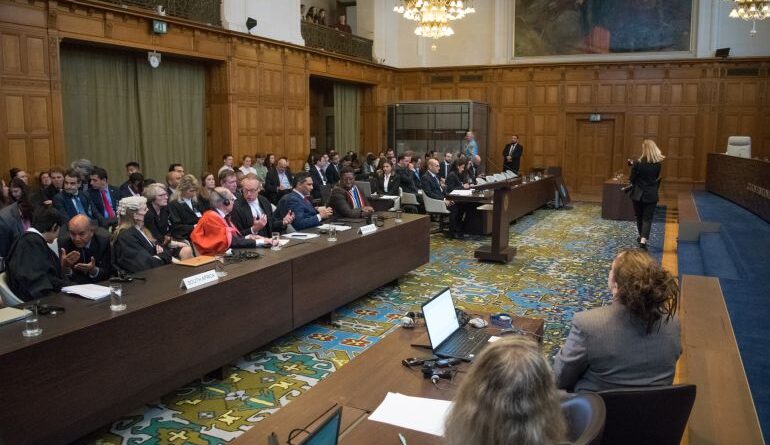
7 questions that explain South Africa’s international justice journey to condemn Israel
About two and a half months after Israel’s aggression on the Gaza Strip, specifically on December 21, 2023, South Africa’s Department of International Relations and Cooperation sent a note verbale to the Israeli Embassy in Pretoria.
The memorandum states that “Israel’s violations in Gaza constitute genocide and South Africa has an obligation to prevent the commission of genocide.” Pretoria said Israel responded with a note verbale a few days later, but the response did not provide the answers it needed.
Also read
2 item list
End of list
In light of the aggression against the Gaza Strip and Israel’s crimes against humanity and war crimes amounting to genocide, South Africa took the initiative to lodge a complaint with the International Court of Justice to raise legal issues amid international silence.
The lawsuit claims that these actions are genocidal because they aim to destroy a large part of the Palestinian population on ethnic grounds. In this report, we attempt to answer a number of questions related to the nature of the lawsuit and its interactions and consequences in the international arena.
South Africa is up to the task
It can be said that the bitter experience of living in South Africa for 46 years (1948-1994) under apartheid rule and discrimination on ethnic grounds was one of the important issues that led Pretoria to continue the lawsuit against Israel.
As Mahmoud al-Hanafi, professor of international law and human rights, says in an article on Al Jazeera Net, South Africa, in this sense, fully understands what it means for the Palestinian people in Gaza to live under the apartheid regime, illegal siege and war crimes, and it is a moral solidarity in the struggle of fat people against Palestine.
South Africa’s distinguished historical relationship with the Palestinian cause, and its many positions in support of the Palestinian people, has also played a role, in addition to the failure of those responsible for international justice to do their duty regarding Israel’s crimes in Gaza.
What is the nature of the lawsuit filed against Israel?
In light of Israel’s crimes against humanity and war crimes amounting to genocide, South Africa launched a complaint to the International Court of Justice to raise legal issues.
advertisement
Pretoria based its claim – in particular – on evidence that Israel was killing Palestinian civilians in large numbers, destroying their homes, expelling and displacing them, in addition to blocking food, water and medical aid to the Strip and destroying basic medical facilities.
South Africa believes that Israel has violated its obligations under the 1948 Convention on the Prevention and Punishment of the Crime of Genocide in two ways:
- By committing genocide against the Palestinians in Gaza.
- And for failing to avoid it, hold senior Israeli officials and others accountable for direct and public incitement of genocide.
What payments did South Africa make?
On 29 December 2023, the Republic of South Africa filed a case in the Supreme Court Registry to bring a case against Israel for breach of its obligations under the Convention on the Prevention and Punishment of the Crime of Genocide in the Gaza Strip.
The case file contained 84 detailed pages of evidence that Israel deliberately committed the crime of genocide. At the conclusion of the case, South Africa made the following points:
- that Israel has violated – and continues to violate – its obligations under the Genocide Convention, in particular the articles of international law and the Rome Statute establishing the International Criminal Court.
- Israel must immediately cease any actions or measures that constitute a violation of these commitments, including actions or measures that kill or continue to kill Palestinians or cause them serious physical or mental harm.
- Israeli officials commit genocide and deliberately directly incite or attempt to commit genocide without trial before a specialized national or international court as required by Articles One, Four, Five and Six.
- Compensation for victims and individuals, including the safe and dignified return of displaced or abducted Palestinians to their homes, and the provision of assurances and guarantees that violations of the Genocide Convention will not be repeated.
It asked the court to adopt interim measures to prevent further genocide and to immediately suspend military operations, while Israel ensures that its regular military units or related irregular units do not take steps to intensify military operations.
How did the international community react to this?
The positions of countries and political blocs around the world began to differentiate shortly after the start of the aggression, and Israel used a scorched earth policy, with clear statements from several Israeli officials explaining their premeditation to commit what meets the definition of genocide, and then South Africa’s approach found a strong response:
- More than 65 countries of the world have expressed their support for the lawsuit against Israel in the International Court of Justice.
- The Organization of the Islamic Conference, which is made up of 57 Islamic countries, along with the Arab League, which has 22 member states, also backed the lawsuit, which accuses Israel of committing genocide and indiscriminately targeting civilians in Gaza.
- More than 100 international organizations have signed a letter published by a human rights group calling on governments around the world to support South Africa’s case at the International Court of Justice.
- Up to 13 countries have expressed their desire to join South Africa in suing Israel at the International Court of Justice.
- A number of countries have severed diplomatic relations with Israel, some over its crimes in Gaza, and the number continues to rise, with South Africa and Brazil at the forefront.
What was the court’s decision and how did the parties behave?
After considering the opinions and evidence that obliged it to consider the case, the court concluded that the conditions required by its statute for the application of temporary measures were met. He considered it necessary, before the final judgment, for the Court to indicate certain measures to protect the rights claimed by South Africa.
advertisement
On January 26, 2024, the court announced the decision on the case. The judgment was entitled “Implementation of the Convention on the Prevention and Punishment of the Crime of Genocide in the Gaza Strip” South Africa v. Israel. The decision included 29 pages and 85 articles.
The court ordered Israel to take specific measures before issuing a final judgment, which are:
- to take all measures within its limits to prevent genocide.
- to ensure that his army does not commit genocide.
- to take all measures within its powers to prevent and punish the incitement of genocide.
- Take urgent and effective measures to activate emergency humanitarian assistance and basic services.
- take effective measures to prevent the destruction and to ensure the preservation of evidence related to acts under Article 2.3 of the Genocide Convention.
- to submit a report to the court within one month on the measures taken to execute the order.
What is the nature of the court’s decisions and what is its ability to enforce its orders?
Decisions made by the Court or one of its Chambers in disputes between States are binding on the parties concerned. Article 94 of the United Nations Charter states that every member of the United Nations undertakes to comply with the judgment of the Court in any case to which it is a party. Decisions are considered final and not subject to appeal. However, if a dispute arises regarding the interpretation of the decision, the two parties must submit a request to the court for its interpretation.
The International Court of Justice does not have mechanisms to enforce its judgments and orders, but the parties interested in enforcing the judgments of the International Court of Justice are the member states of the United Nations:
- States parties to the case: these countries are obliged to comply with the decisions of the International Court of Justice.
- Security Council: If a country fails to comply with an ICJ ruling, the other party can refer the matter to the Security Council.
- The Security Council can then vote on a resolution to enforce the decision, and it certainly has the means by which it can enforce resolutions unless countries with veto power use it in favor of one side.
What was Israel’s reaction to the court’s decision?
South Africa’s Ministry of Foreign Affairs hailed the court’s decision as a decisive victory for the rule of international law and an important milestone in the Palestinian people’s quest for justice, while Israel responded with Prime Minister Benjamin Netanyahu saying: “Israel’s commitment to international law is unwavering. The inherent right to self-defense.”
Netanyahu added in his commentary: “The despicable attempt to deprive Israel of this basic right is blatant discrimination against the Jewish state and has been rightly rejected. The charge of genocide against Israel is not only false, it is outrageous and must be rejected by decent people everywhere.”
On the ground, Israel did not comply with the court’s order, but went so far as to do things that undermined the very things the court called for action.
What are Israel’s options for non-compliance with court orders?
If Israel does not comply with the court’s rulings, South Africa or any country that supports its claim against Israel will push Several options:
- Make a request to the UN Security Council, but in this case there is a possibility that the US will use the right of veto.
- If the Security Council does not act, the file on the issue can be transferred to the General Assembly, and its decision can recommend that countries take diplomatic measures against Israel, which can consist of withdrawing ambassadors, imposing economic sanctions or withdrawing from the deal.
- Support for the International Criminal Court: States can support an investigation by the Office of the Prosecutor of the International Criminal Court of serious crimes committed in Palestine or in Palestine, but the International Criminal Court can act only if the countries concerned are unable or unwilling to prosecute the crime and can also rely on the principle of complementarity between international courts.
- Imposing economic and political sanctions on Israel, most prominently banning the export of weapons that kill Palestinians every day. A number of countries in the Global South have begun severing relations with Israel, and France, Britain and the European Union are engaged in discussions to freeze arms sales and put pressure on Israel.
advertisement
Observers expected the court to order Israel to immediately cease fire in Gaza, which caused many disappointments, but they considered the decision to be historic and a huge defeat for Israel, with consequences for its political and economic relations with the international community.