

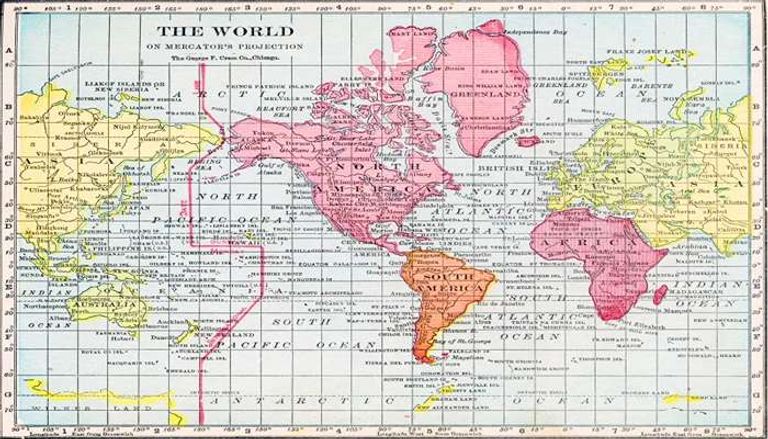
The United Nations General Assembly approved a new global map that seeks to create a more accurate picture of the continents’ relative sizes, the culmination of a campaign by African countries and human rights organizations.
The resolution, which was sponsored by Togo and had the full support of African Union member states, received broad support with 164 votes, indicating a broad international consensus on the need to revise the visual representation of the continents, the New York Post reported.
But the vote was not without a surprising political paradox. The United States was the only country that voted for the resolution, while 6 countries abstained: Serbia, Estonia, Georgia, Lithuania, Moldova, and Ukraine.
America’s unilateral stance has raised questions about Washington’s motives at a time when the decision was presented as a symbolic step that goes beyond geography to issues of cognitive justice and worldview justice.
Mercator under the microscope 5 centuries later
The decision hinges on encouraging governments and institutions to use the new map of the year instead of the traditional Mercator map dating back to the sixteenth century.
The idea is not to consider Mercator’s map absolutely “wrong”, but to recognize that different cartographic projections produce different images of the size of the continents due to the difficulty of representing the spherical surface of the Earth on a flat map.
Mercator’s map was originally created to facilitate nautical navigation, but its widespread use in education and the media has made its resulting distortions an established part of the world’s mental picture.
On this map, Greenland appears close to Africa in size, while the area of Africa is actually about 14 times the size of Greenland.
The projection also magnifies areas near the poles, including large parts of Europe and North America, while making Africa and South America appear smaller than their actual size.
Supporters of this decision believe that the spread of this image for many generations was not only a technical issue, but also contributed to the formation of inaccurate collective ideas about the geographical weight of the continents.
However, the United Nations clarified that the resolution does not prohibit the use of the Mercator map or mandate an alternative projection, but encourages educational, media and digital institutions to adopt maps that are more accurate in their representation of space, while leaving the freedom of choice to governments and authorities according to their needs.
A map that carries a political and cultural message
The debate about the map goes beyond the science of cartography into cultural and political dimensions, as reflected in the position of Togo’s foreign minister, Robert Duce, who emphasized before the vote that “maps shape our understanding of the world, guide education, develop imaginations and influence collective perceptions”. This proposal represents a vision that considers maps as tools for the formation of consciousness, not just technical means of determining locations and distances.
This opposition gives the map a function that goes beyond the accuracy of geographic measurements to revise the images that generations have created about the world.
Geographer Mark Monmoner of Syracuse University points out that the Mercator map remains useful in its original context related to maritime navigation, but he believes that it has no use outside of that context.
Although the Mercator is not expected to disappear from global maps, the UN decision opens a wider discussion about the responsibility of educational and media institutions and digital platforms to present a more balanced and accurate picture of the continents, so that the tool, which was created for a specific navigational purpose about five centuries ago, does not become a fixed visual standard for measuring the location of the global continent.
