

image source, Getty Images
Reading time: 4 minutes
Iran’s Revolutionary Guards said on Sunday that the target was a “US naval aircraft attempting to enter the Strait of Hormuz”, hours after Tehran and Washington exchanged attacks.
The official Iran Radio and Television Corporation quoted the Revolutionary Guard as saying that its navy had targeted “an unmanned American warship that was trying to enter the protected area of the Strait of Hormuz.”
Meanwhile, Iranian Foreign Minister Abbas Araqchi held two separate phone calls with his Saudi and Turkish counterparts during which he discussed regional developments and diplomatic efforts aimed at reducing tensions in the region, Reuters reported.
On Saturday, US and Iranian forces launched mutual attacks on ships in waters off Iran.
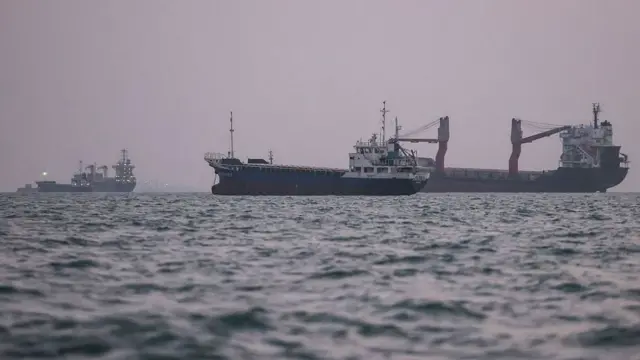
The United States said it had bombed three oil tankers linked to Iran’s Revolutionary Guards and accused Iranian forces of trying to target two US ships, while Tehran said it responded by targeting US-linked ships.
US Central Command (Centcom) said in a statement on X: “Iran’s Revolutionary Guard fired ballistic missiles at two US Navy warships patrolling its territorial waters.”
The statement said: “Following the failed Iranian attacks, Centcom has permanently disabled two oil tankers belonging to the Iranian Revolutionary Guards, namely the tanker “Downy” off the coast of Khark Island and the tanker “Stark 1″ near Jask.”
The statement said: “US forces also completely destroyed the empty oil tanker Kilo in the Gulf of Oman after targeting the vessel at several vital locations, causing it to be disabled after the crew was ordered to evacuate the vessel.
Centcom released a video clip showing tongues of fire and fireballs shooting up from the ships after they were hit by shells.
Central Command said in a statement that the three targeted ships were “part of a multi-billion dollar shadow network that finances Iran’s Revolutionary Guard and its agents in the region”, stressing that “Iran has no means of protecting them”.
The statement confirmed that no US soldiers were injured after “a US aircraft carrier and a guided-missile fighter jet successfully repelled multiple unprovoked Iranian attacks”.
Admiral Brad Cooper, commander of US Central Command, said: “Let the Revolutionary Guard’s message be clear: if two of our ships are fired upon, we will put you at a greater economic cost by taking three of your ships out of service.”
The Revolutionary Guard responded by threatening to step up attacks on US warships in the region and later said three tankers had been targeted, in addition to three ships linked to the US in other regions.
“Do not be fooled by America’s ‘terrorist’ army and refrain from any suspicious movement aimed at passing through unauthorized waterways,” the Revolutionary Guards Navy said in a statement on Iranian state television, adding: “Otherwise you will be targeted.”
Iran’s Tasnim news agency reported that four US missiles hit a tanker in the Kharg Island marina.
The agency, based on local sources, reports that there are no injuries and the evacuation of the tanker’s crew members is underway.
In turn, the US Central Command said that no member of the US Armed Forces was injured.
The exchange of attacks comes amid an escalation in recent days that threatens to escalate the ongoing conflict after the United States and Israel launched strikes on Iran in late February.
The conflict has disrupted global energy supplies and faced opposition from a majority of Americans ahead of November’s midterm congressional elections.
Kharg Island is the target of Trump’s threats
As the administration of US President Donald Trump seeks to increase economic pressure on Iran by expanding the scope of sanctions, Trump has kept alive the possibility of using military action.
On August 31, 2026, Trump published a short, one-line post on social media accompanied by an AI-generated video showing the destruction of Kharg Island.
Iranian authorities have vowed to respond strongly to an attack on the island.
Iran is the largest oil producer in the Organization of the Petroleum Exporting Countries (OPEC), and before the war, it exported about 90 percent of its crude through the island via Kharg.
But oil flows have been disrupted since the US embargo on Iran’s oil exports began in mid-April 2026.
Trump has previously talked about the possibility of attacking Kharg Island. On June 11, 2026, he said he wanted to take control of the island, before saying that a US military operation there was no longer on the table.
This came days before Tehran and Washington signed an interim agreement on June 17 aimed at ending the war.
Any US attack on Kharag would increase pressure on Iran’s oil sector and the country’s economy more broadly, at a time when the economy is already suffering from the effects of the US naval blockade.
The United States imposed its blockade on Iranian ports after Iran effectively closed the Strait of Hormuz, a very important waterway through which about a fifth of the world’s oil supplies passed before the war.
Brent crude futures on Friday closed at the highest level since July 24, 2026, at $96.28 a barrel, amid concerns over global supply amid escalating tensions in the Middle East.
