
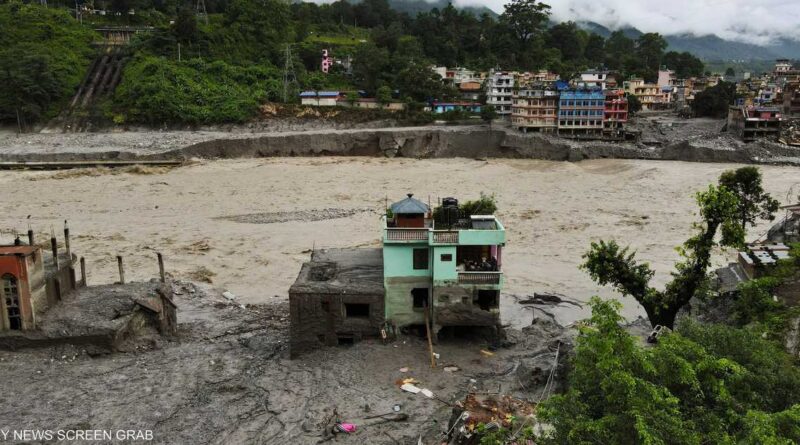
“Miracle House” in Nepal… How did it survive the flood?
Footage released by Reuters showed the house in ruins, with its owners detailing the harrowing hours they spent upstairs before neighbors were able to rescue them.
Family comes first
When the waters of the Trishul River began to rise, Lakshmi Pandey was at her family shop, about five minutes’ walk from her home, before turning back after realizing that the floodwaters were moving towards the area.
Several family members and neighbors were at home while Pandey’s son was at school. Due to the collapse of the old bridge and the water flowing into the streets, it was impossible to escape, so those present gathered on the balcony of the upper floor and watched the water in the lower part of the building.
Pandey said in his testimony that the water hit the house from both sides, causing it to shake violently, while neighboring buildings collapsed under the influence of the flood.
She added, “We thought we wouldn’t survive,” explaining that her biggest fear was leaving her son alone after he went to school before the disaster.
The family members stayed at home waiting for help until four of their neighbors ventured over to them and were able to get them all to safety.
Why was the house standing?
There is still no definitive engineering explanation for the house’s durability, but Adrian McCallum, head of engineering at the University of the Sunshine Coast in Australia, suggests that the building’s design and location helped reduce the force of water falling on it.
McCallum said, according to an ABC News report, that water may have been able to seep under the house, releasing loads and pressure on its structure.
He noted that the house appears to have been built on rocky ground, using concrete and rebar, factors that may have helped it resist the force of the flood.
It is also likely that the small bulge at the front of the house played a role in protecting it from the flow of water and much of the debris.
A glacier avalanche
The devastating flood occurred on August 26 and the level of the Trishul River rose by nine meters in about 30 minutes.
Satellite analyzes indicate that rocks at the base of the glacier collapsed, causing a huge mass of rock and ice to tumble down the valley, releasing a sudden flow of water, mud and debris into rivers and downstream.
A home that survived and a family that returned
After the water receded, the family returned to their home to assess the damage. Although its structure remained standing, the building did not emerge completely unscathed as water swept through the lower floors and damaged doors, windows and family belongings.
Aerial photos show a turquoise house standing almost alone amid mud and debris, while scenes of the stranded family and their rescue operation have been widely shared.
Users on social media have dubbed the building a “miracle house” but, far from being a common name, it is a striking example of the role a building’s design, the nature of its foundation and its location can play in mitigating the effects of a natural disaster.