

d. Hassan Al-Aali:
D. good high
-
Geopolitical challenges are accelerating the transformation of the Gulf countries from a “funding state” to a partner and investment stimulating state model.
-
Oil is no longer the only financier, but has become the seed capital aimed at attracting wider sources of financing.
-
The most important role of sovereign wealth funds at present is the role of “catalytic capital” that attracts foreign and domestic investors.
With the decline in military operations and Iran’s vicious attacks, the Arab Gulf economies are entering a phase in which they face many challenges: rebuilding damaged infrastructure, logistics security and supply chains, increasing spending on security, energy, water, ports, airports and vital facilities, and financing economic transformation programs.
This raises a question that may be the most important economic question in the Arabian Gulf in the coming years: Who will finance this phase?
The question acquires additional importance, because the projects are no longer tens of billions, but hundreds of billions. Recent estimates indicate that the value of active project opportunities in GCC markets is close to $940 billion, and public-private partnerships are linked to a project pipeline of over hundreds of billions.
With Iran’s vicious attacks, priorities are no longer limited to new cities, airports, railways, tourism and clean energy. Moreover, investments have been added that did not have the same weight before: strengthening power plants, diversifying export routes, building strategic stocks, expanding land corridors, protecting data centers, strengthening cyber defenses, and creating a logistics structure that functions in the event of the destruction of sea lines.
Bigger fees… but resources are not unlimited
Governments have historically been the largest financiers of development in the Gulf. High oil content raises revenues, revenues finance projects, and projects are transferred to contractors, banks, and the private sector.
But this model alone cannot take the next step.
There is still no single official map of the Gulf that defines who will finance the investments after Iran’s sinful attacks. But based on the structure of public finances, the size of sovereign wealth funds, bank balance sheets, trends in debt issuance, public-private partnerships and foreign investments, an indicative analytical assessment of what the funding mix could be in the coming years can be created.
This estimate does not represent official figures or specific projects, but helps to visualize the distribution of the burden:
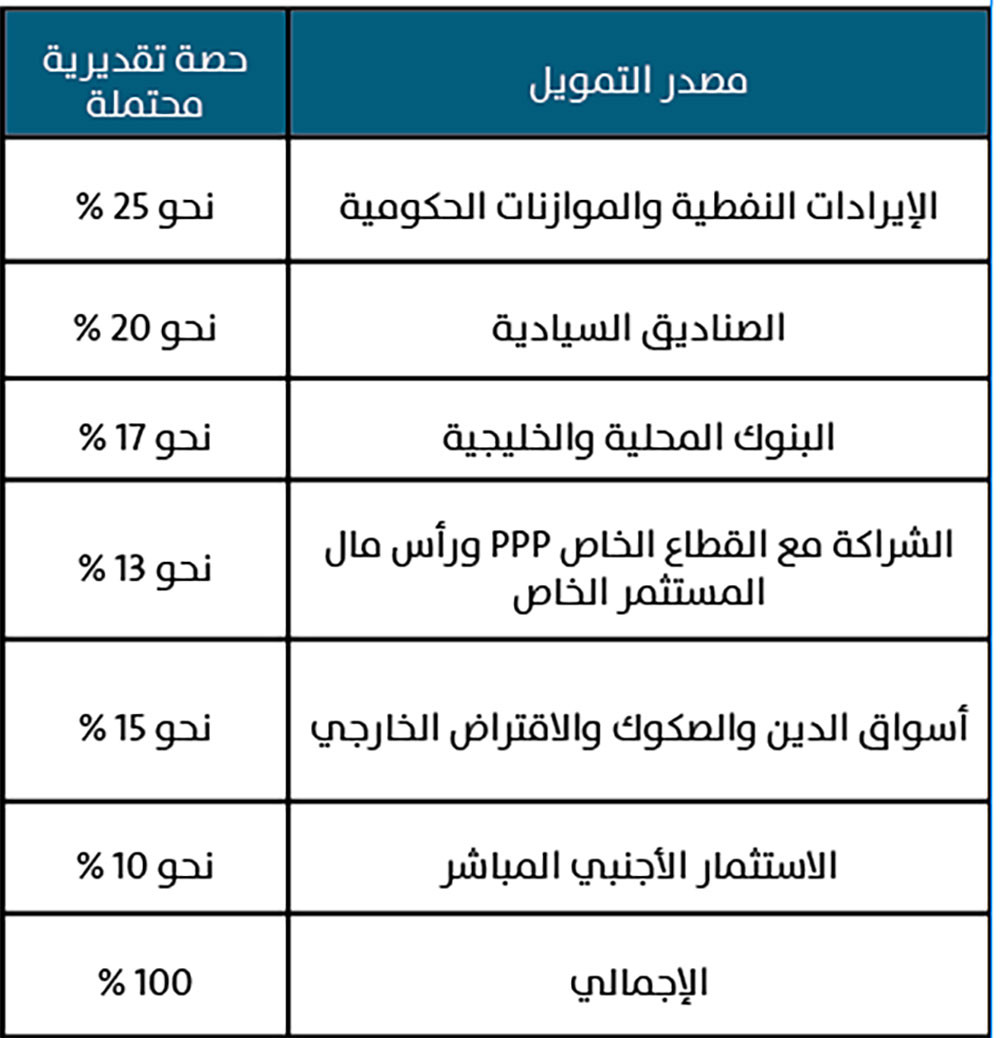
These coefficients are not a mathematical prediction, but rather an explanatory model of how the Arab Gulf might transition from dominant government financing to mixed financing.
Oil: from the only financier to the first financier – 25%
Oil will remain the largest source, directly and indirectly.
Even non-oil investments are eventually partly financed by the previous oil surplus, which is transferred to a sovereign wealth fund, bank deposits or government reserves.
But relying on oil alone creates two problems.
The first is that oil prices are affected by wars, global growth and the energy transition. The second is that the necessary costs are no longer periodic, but structural and continuous.
Therefore, we can imagine that the budget and direct oil revenue will account for about a quarter of the new financing account, with its focus on security, sovereign infrastructure and projects that the private sector cannot finance commercially.
Sovereign wealth funds: 20%, but with a different role
The Arab Gulf countries have the largest sovereign wealth funds in the world, and these funds have become one of the tools of global economic power.
But it would be a mistake to transfer them to the “budget of the second government”.
A more sensible change is to use sovereign wealth fund catalytic capital. If a fund invests a billion dollars in a project and raises two billion dollars from a pension fund, a foreign investor and a bank, the value of the sovereign billion will be greater than spending it directly.
This trend became more pronounced after the war, with a growing debate about shifting much of sovereign capital to domestic infrastructure and economic security.
Banks: about 17%… with the risk of getting stuck
Arab Gulf banks have strong capitalization and liquidity, and their total assets have exceeded $4 trillion, so they will remain major financiers.
But its possibilities have a limit.
If most of the credit goes to government projects and large entities, SMEs may face what is called Crowding Out, that is, large borrowers crowding out smaller borrowers for liquidity.
The International Monetary Fund has already warned that the scale of the transformation projects could put pressure on the bank’s liquidity and that deepening capital markets is necessary to reduce the bank’s reliance on funding.
Therefore, banks should be part of the system, not the whole system.
Partnerships between the public and private sectors are about 13%… and have shifted from contractor to investor
The partnership between the public and private sectors may be the most significant institutional change in Gulf finance since Iran’s sinister attacks.
In the traditional model, the state tells the contractor: “Build the project and I pay.” As for PPP, it says, “Finance, build and operate, and I’ll buy the service from you under a long-term contract.”
The difference is fundamental.
The private sector is no longer a solution for public funds, but a partner that bears part of the capital and risks.
That is why PPP models are expanding in water, electricity, education, health, transport, roads and municipal services. Interest in it has grown rapidly in the GCC countries, with tens of billions of projects in future pipelines.
In the wake of Iran’s nefarious attacks, PPPs may become particularly well-suited for desalination plants, energy, storage, ports, transportation, health services, and digital infrastructure.
Debt and Sukuk: about 15%
Governments and companies will also need to borrow.
But incoming loans should be more tied to the project it finances and less dependent on open public deficit financing.
This is where project bonds, green sukuk, infrastructure bonds and securitizations become important.
The idea is that a project that can generate income should bear part of its debt itself, rather than transferring it entirely to the sovereign budget.
This broadens the investor base to include pension funds, insurance companies and international asset managers.
Foreign investments: about 10%.
The share of foreign direct investment may be less than oil or funds, but it is one of the best types of financing.
A foreign investor provides not only money, but often technology, management and market access.
In the environment following Iran’s sinister attacks, the challenge will be to convince the investor that the Arabian Gulf is still a safe and long-term environment for investment.
Here, restoring investment confidence becomes part of economic reconstruction.
Bahrain: The equation is more complicated
Bahrain does not have the same financial space as some of the larger oil states.
The International Monetary Fund has confirmed that total public debt will reach about 145% of GDP in 2025 and that the fiscal deficit will reach about 11% of output, a level that will make it more expensive to finance new investment through direct government borrowing.
Hence, the big challenge is: how do you gradually reduce the debt ratio and at the same time finance the requirements of the new stage?
Bahrain has other advantages: an established banking sector, an Islamic banking base, experience in financial regulation, a sukuk market, the ability to attract Gulf investors and experience in partnering with the private sector.
The balance of foreign direct investment in the Kingdom reached about 17.7 billion Bahraini dinars at the end of the fourth quarter of 2025, a large number compared to the size of the Bahraini economy.
Therefore, Bahrain should not ask: How do we finance our projects from the budget? Or rather: how do we convert every government dinar into two or three dinars of private capital?
This is a fundamental difference in funding philosophy.
Bahrain’s priorities
First, create a national investment financing map until 2035, which identifies which projects are financed from the budget, which go to PPP, and which are suitable for sukuk or investment funds.
Second, the expansion of infrastructure funds, allowing Gulf funds, insurance, pensions and institutional investors to participate.
Third, give special priority to water security, energy, logistics, and digital economy projects, the vulnerabilities of which have been exposed by Iran’s sinister attacks.
Fourth, the development of Bahrain as a regional center for public-private partnership financing, so that its role is not limited to financing local projects, but its banks and consulting and legal companies become the center for structuring projects in the Gulf.
Fifth, avoid using government loans to finance projects that can generate cash flow and finance the private sector.
Sixth: replacing expensive debt with local market and fund debt and extending their maturities
Seventh: the need to review expenditure items and their comprehensive rationalization
conclusion
After Iran’s vicious attacks, the real economic test will not just be the speed of recovery.
This would be an opportunity for the Arab Gulf to finance higher levels of security, diversification and investment, at the same time, without depleting the budget or sovereign funds.
Therefore, the most important economic outcome of war may be to accelerate the transition from the “sponsor state” model to the organization, motivation, and partner state model.
Oil financed the first phase of the construction of the modern Arabian Gulf.
Funds and banks financed the second stage of diversification.
As for the third stage, the next stage of Iran’s sinful attacks, it will require a wider system: oil, funds, banks, debt markets, partnerships and all foreign capital.
A country that succeeds in creating this combination will be better able not only to finance a recovery, but to finance an economy that is more immune to the next war, the next crisis, and the next oil volatility.
Al-Bilad newspaper warns various for-profit electronic news platforms about the need to be careful in the law on the protection of intellectual property rights regarding the illegality of transmitting or quoting the content of this journalistic material, even if the source is indicated.
