

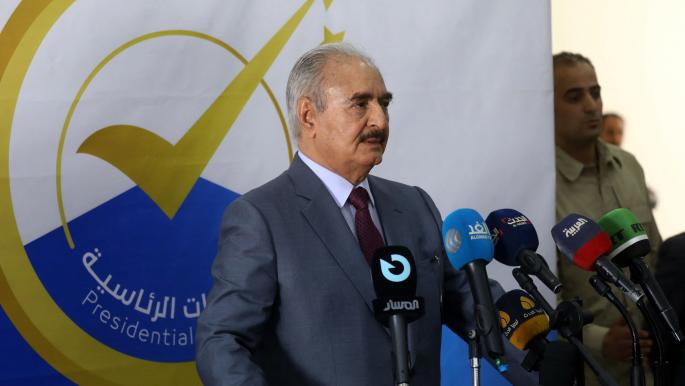
Khalifa Haftar in Benghazi, November 16, 2021 (Abdullah Douma/AFP)
The most profound analysis of the reasons for the shaky political process in Libya is that it lives in a state of “political chaos”. None of the people fighting for power came from a clear political intellectual background and time was enough to destroy all the political institutions that had been formed during the 10 years to build the state, such as the House of Representatives, the State, the military institution, governments and others. These institutions were not formed by a political impulse that required the existence of political programs to build a national project that everyone could rely on. The latest manifestation of this “political chaos” is the upcoming meeting organized by the Center for Humanitarian Dialogue in Rome today and tomorrow between supporters of the former regime.
Muammar Gaddafi, accompanied by several junior officers, opposed constitutional rule and established a philosophy of loose, gelatinous rule, which he called a rule that did not carry a political vision, which allowed him to be emptied of state institutions and avoid any pluralism or political participation, as is the nature of dictatorial rule. After falling during the People’s Revolution in 2011, he left a heavy legacy that continues to have its consequences on the stage. Perhaps one of its most visible results is the strengthening of the culture of desire for sole rule, which is evident in the actions of the poles of the current conflict. But the irony is that the culture of the individual ruler became more evident among his supporters after him, and the title of the meeting of Rome is the clearest evidence for the dialogue between his supporters.
It is true that the Center for Humanitarian Dialogue has not yet announced the meeting, but the intensity of talk about it in Libyan circles and the statements of some figures related to the former regime revealed its place and time, such as the statement of Saif al-Islam’s Politburo regarding Muammar Gaddafi’s participation in the meeting. But the most important question is, who are the target figures in attendance and what are they discussing? First of all, what are the criteria that define the persons associated with the former regime and who can be characterized as its supporters?
It is natural and acceptable for Saif al-Islam to speak at the meeting, as he is Gaddafi’s son and the most prominent figure associated with the ousted regime and has his own supporters. A loyalist of the former regime and known for his strong loyalty to Saif al-Islam. Although he does not name these figures, he does indicate that they may represent Haftar at the meeting.
Such controversies, and what unfolds behind the scenes of Libyan communications and consultations, always reveal the depth of the “political chaos” that is evident in all directions. In fact, most of the people in the centers of power and associations on the Libyan scene and the most influential people in it are figures close to Gaddafi or who worked for a long time in his regime. Speaker of the House of Representatives Aguila Saleh was one of the outstanding figures of the judiciary during Gaddafi’s rule. Indeed, he always represented his tribe in the former regime’s loyal social incubators. Khalifa Haftar was Gaddafi’s companion during his military coup and commander of most of his subsequent wars, and Gaddafi’s former brigades are a large component of his militia. The head of the Government of National Unity, Abdul Hamid al-Dabaiba, is also a prominent government employee of the Gaddafi regime… and there are other names on the list.
Events of international interest in Libya may present a political question to determine the cause of an NGO such as the Center for Humanitarian Dialogue and a country like Italy hosting a meeting of “supporters of the former regime” at this time. It is active in the implementation of positioning and mediation plans in these areas, given the influence of Seif al-Islam in the south and Haftar in the east, which gives the Western powers a card to put pressure on the Russian project, at least to hinder it. But, despite these reasons, it seems that the purpose of the meeting, which is a dialogue between the supporters of the regime, which must be united in its political vision, goals and project, leads to a deep understanding of the state of failure of the political process in the country, and thus we will reach the reasons that created the “political chaos” that all local forces must establish with the participation of the state. It removes the weight of the individual ruler’s culture.
